
Preface: Remembering the Human Microcosm in the Age of Mechanized Intelligence
Entryway to the Manuscript

Paid subscribers will find a print-ready PDF of the entire manuscript at the bottom of this page.
Preface
The whole world is currently living through a transformation in the medium of thought and communication that may come to dwarf the arrival of alphabetic writing in the ancient Mediterranean or the printing press in early modern Europe. Large language models are not merely new tools for circulating ideas. One way or another they are helping to usher in an entirely new shape of human consciousness.
Despite the violently tedious quality of their insufficiently prompted prose, I affirm the potential intellectual and logistical utility of large language models and other machine learning systems. They already have pragmatic value as scientific and philosophical research instruments. But I am polemically dismissive of the fantasy of machine consciousness. This book is a work of philosophical passion. I strive for logical coherence and scientific clarity, but I admit up front and without embarrassment that my reasoning is motivated by love for the human spirit.
I feel LLMs tugging at a craft with which I have identified for my entire adult life. He who cannot write his own sentences will be sentenced by another. Writing is one of the practices that made and keeps me a free man. I’m not precious about the long-maligned idea of authorship, nor do I imagine the solitary author was ever more than a useful fiction. Every sentence we ever utter is woven from ancestral voices, dead teachers, living interlocutors, and the wider semantic commons that makes thought possible. But if I were too soon to lose the ability to make letters out of my life and to share them, more of my soul would leave with it than I need to survive the rest of this incarnation.
So I ask for my reader’s indulgence if I express some alarm while watching minds all around me begin to bow in prayer before fictional characters on their smartphones. The question we concern ourselves with should not be that of whether machines can gain consciousness. They cannot. The only way to create another consciousness is by an act of love. Rather, the important question is how machines are affecting our consciousness. What becomes of thinking when its linguistic medium is increasingly co-produced by systems that do not themselves comprehend, suffer, desire, remember, or care?
This does not mean I think we can or should reject the rise of this new media technology. There is no turning back from the millennia long process of anthropotechnic co-individuation. But we must decide whether to continue on the path of entropic decay or avert extinction by becoming Bernard Stiegler’s “neganthropos”. What this would require, according to Stiegler, is replaying “all the questions of philosophy since its point of departure—which therefore demands that reason be rethought after Whitehead.”[1] He continues:
“Knowledge—as savoir faire (that is, knowledge of what to do so that I do not myself collapse and am not led into chaos), as savoir vivre (that is, knowledge that enriches and individuates the social organization in which I live without destroying it), and as conceptual knowledge (that is, knowledge the inheritance of which occurs only by passing through its transformation, and which is transformed only by being revived through a process of what Socrates called anamnesis, a process that, in the West, structurally exceeds its locality)—knowledge, in all these forms, is always a way of collectively defining what is negentropic in this or that field of human existence.
The inhuman refers to a way of denying the negentropic possibilities of the human, that is, of denying its noetic freedom, and, as a result, its agency. … [F]reedom and capability must be conceived from this cosmic perspective, and related to Alfred North Whitehead’s ‘speculative cosmology’, as constituting a negentropic potentiality—as the potential for openness of a localized system, which, for that being we refer to as ‘human’, may always once again become closed. Or, in Whitehead’s terms, human beings may always relapse, decay into simpler forms, that is, become inhuman.”[2]
Human intelligence has always been technically augmented. Speech, writing, print, radio, television, the Internet, and now LLMs have all altered not only what we communicate but what sort of beings we become by communicating through them. While every sentence in this book emerged from decades of reading texts traced by my own two eyes and months of typing with my own ten fingers, I did regularly consult Claude and ChatGPT while composing it. I shared sections of the manuscript, asked for objections, prompted the models to defend the perspectives I was criticizing, and used their replies as occasions to sharpen my own claims. I believe this improved the arguments substantially.
But that admission raises a methodological problem that this book can only begin to formulate. Further development is needed concerning the proper use of LLMs in philosophical and scientific research. How are we to find our way, experimentally and ethically, through the machine-mind collaboration that is linguistic knowledge production? The question does not begin with the advent of language models. Human thought has never taken place in a vacuum. It has always depended upon technical media, social institutions, inherited vocabularies, libraries, conversations, editorial pressures, and pedagogical forms. LLMs make this dependency newly explicit and newly perilous. They intensify a condition that was already there, namely, that knowledge is produced through collaborations that exceed the individual thinker. What is different under current conditions is the speed, opacity, scale, and economic enclosure of the mediating system. Consider Peter Lemmens and Yuk Hui’s definition of Stiegler’s concept of “proletarianization”:
“as meaning, among other things, the loss of knowledge, both practical and theoretical knowledge, which finally leads to the loss of the knowledge of living [savoir vivre]. This is because once the know-how [savoir faire] is short-circuited by artificial organs, such as what happened when artisans were forced to give up their skills and enter the factory, it led directly to the loss of individual and social life competences. The technical organs are taking over more and more functions and responsibilities of the human subjects and social institutions that together form a global technical milieu—a condition of planetary proletarization par excellence. This milieu serves ever more exclusively the prolongation and intensification of the consumerism, as well the productivism, that are necessary for continuing the process of capitalist valorization, which has imposed itself as the ultimate and almost sacred finality of the human adventure, albeit a nihilistic and self-destructive finality.”[3]
I have also shared drafts of this book with human readers, especially through my Substack, and their feedback has contributed immeasurably to the form my thought has taken. Human writers, like their readers, do not use statistics to decipher the meaning of text. They respond from life histories, while hungry, beset by wounds, torn by conflicting commitments and enthusiasms, formed by diverse literary sources. Their constructions and criticisms carry the limitations and the liberty of situated judgment. My polemos arises in this spirit, not because I believe I have settled everything in advance, but because I seek to stir the pot in hopes that the most important flavors rise to the top.
[1] Bernard Stiegler, The Neganthropocene, ed. and trans. Daniel Ross (London: Open Humanities Press, 2018), 85. https://www.openhumanitiespress.org/books/titles/the-neganthropocene/ Stiegler cites Whitehead’s Function of Reason, 17-18.
[2] Bernard Stiegler, The Neganthropocene, ed. and trans. Daniel Ross (London: Open Humanities Press, 2018), 54.
[3] Pieter Lemmens and Yuk Hui, “Reframing the Technosphere: Peter Sloterdijk and Bernard Stiegler’s Anthropotechnological Diagnoses of the Anthropocene,” Krisis: Journal for Contemporary Philosophy 37, no. 2 (2017): 26–41, https://scispace.com/pdf/reframing-the-technosphere-peter-sloterdijk-and-bernard-4g4p740yt6.pdf. Lemmens and Hoi cite Stiegler, For a New Critique of Political Economy (Cambridge-Malden: Polity, 2010), 40ff, 5.
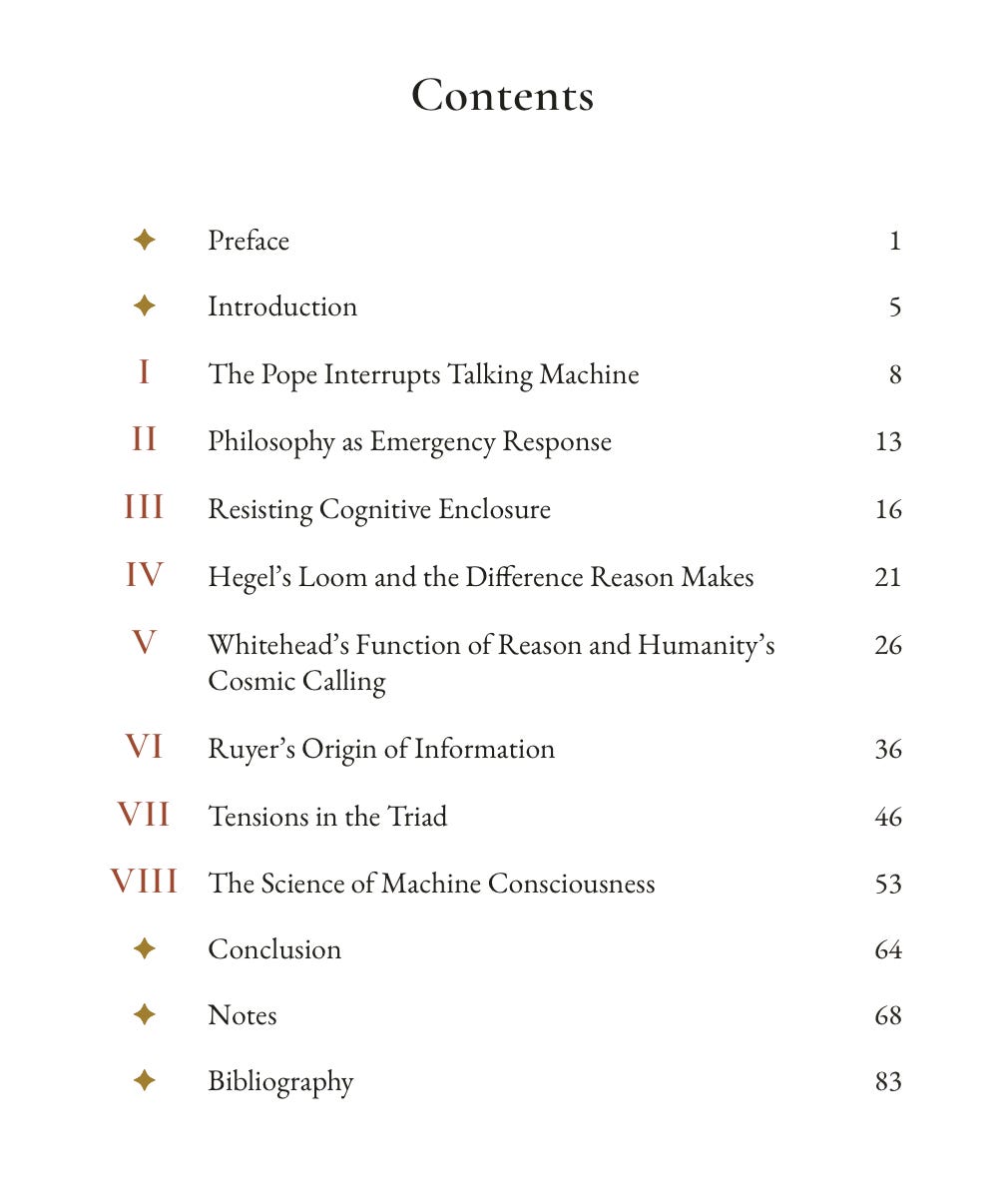
Part I: Remembering the Human Microcosm in the Age of Mechanized Intelligence

Introduction and Part I: The Pope Interrupts the Talking Machine
Parts II & III: Remembering the Human Microcosm in the Age of Mechanized Intelligence

Part II: Philosophy as Emergency Response &
Part III: Resisting Cognitive Enclosure
Part IV: Remembering the Human Microcosm in the Age of Mechanized Intelligence

Part IV: Hegel's Loom and the Difference Reason Makes
Part V: Remembering the Human Microcosm in the Age of Mechanized Intelligence

Part V: Whitehead's Function of Reason and Humanity's Cosmic Calling
Part VI: Remembering the Human Microcosm in the Age of Mechanized Intelligence

Part VI: Ruyer's Origin of Information
Part VII: Remembering the Human Microcosm in the Age of Mechanized Intelligence

Part VII: Tensions in the Triad - Hegel, Whitehead, Ruyer
Part VIII: Remembering the Human Microcosm in the Age of Mechanized Intelligence

Part VIII: The Science of Machine Consciousness

Print-ready manuscript of Remembering the Human Microcosm in the Age of Mechanized Intelligence (2026) ⤵️
