
Part VI: Remembering the Human Microcosm in the Age of Mechanized Intelligence
Part VI: Ruyer's Origin of Information

Part I: The Pope Interrupts the Talking Machine

Part II: Philosophy as Emergency Response &
Part III: Resisting Cognitive Enclosure

Part IV: Hegel’s Loom and the Difference Reason Makes

Part V: Whitehead’s Function of Reason and Humanity’s Cosmic Calling

Part VI: Ruyer’s Origin of Information
Ruyer’s 1954 book, only recently translated as Cybernetics and the Origin of Information in 2024, is among the most penetrating and prescient philosophical engagements with the then new science of information.[1] Far from a romantic technophobe, he provides an ideal witness to the mythological origin of cybernetics. He was also a deep reader of Whitehead, with whom he critically engages in his masterwork Néo-finalisme (1952), protesting alongside him the equation of living organisms with machines. Ruyer shares the decisive distinction between aggregates and individuals:
“Every being, every center of activity, is its own subject and possesses itself. Every being that is not an aggregate, every ‘organic’ being in the broad sense in which Whitehead uses this term—which also includes the individualities of physics and chemistry—is a form, that is, directly self-possession, ‘for-itself’ as well as ‘in-itself.’”[2]
As we have seen, Whitehead generalized the field physics of his day into a cosmology of prehensive feeling composed of internally related occasions. Ruyer analogously generalized the study of embryogenesis into a panpsychist ontology organized around his signature concepts of self-survey, form, and trans-spatial themes. Ruyer’s survol—a living agent’s nonlocal survey of its own activity—converges with what Whitehead calls the “subjective immediacy” of an actual occasion—the momentary “for-itself” of its own self-enjoyed becoming before it perishes to become a “superject” bequeathed to others.[3] Ruyer’s thèmes correspond closely to the activity of Whitehead’s mental pole, when an occasion’s survey reaches adjacently to the actual for relevant possibilities, that is, for novel proposals or “lures for feeling.”[4] Thèmes are lures, the conceptual appetite for ideals not yet actualized.
For Ruyer, the activity of self-survey is “absolute,” meaning it is “not relative to any point of view external to it” since it “knows itself without observing itself.”[5] It requires no second seer behind its seeing, no little homunculus in a Cartesian theater. We survey our own visual field directly without calling upon a second surveyor. This is what distinguishes an individual or “forme vraie”—a true form (an actual occasion or res verae, in Whitehead’s terms)—from aggregates or statistical “phénomènes de foule”—crowd phenomena (in Whitehead’s terms, “societies”).[6] Self-survey is what no machine possesses, since a machine is assembled partes extra partes by the engineer who builds it and surveyed only from the outside by the user of its outputs. As with Whitehead’s process of concrescence, wherein the genesis of an occasion of experience does not occur within an already constituted space-time, the meaningful themes actualized by Ruyer’s organic forms “[belong] to an order other than that of spatiotemporal composition.”[7] En masse, actual occasions, upon perishing, often assemble into aggregate societies, producing externalized and so measurable, calculable effects. But denying the organic unity of true forms would be like denying the individual subjective lives of billions of mollusks whose shells formed limestone sediments “on the grounds that the sediments as such obey physical laws.”[8]
In short, machines like all aggregates belong wholly to the domain of what Ruyer calls liaison, or linkage observable from without, whereas organisms belong to the domain of survol, or activity present to itself. The physical or biological structure that presents itself to the mechanist as reducible to its parts is but the “spatial symptom of a far more fundamental system of binding forces [forces de liaison].”[9] In Whithead’s terms, what appears at the inorganic level of statistical crowds like a mechanical push is really a prehension or transmission of attenuated feeling from occasion to occasion.
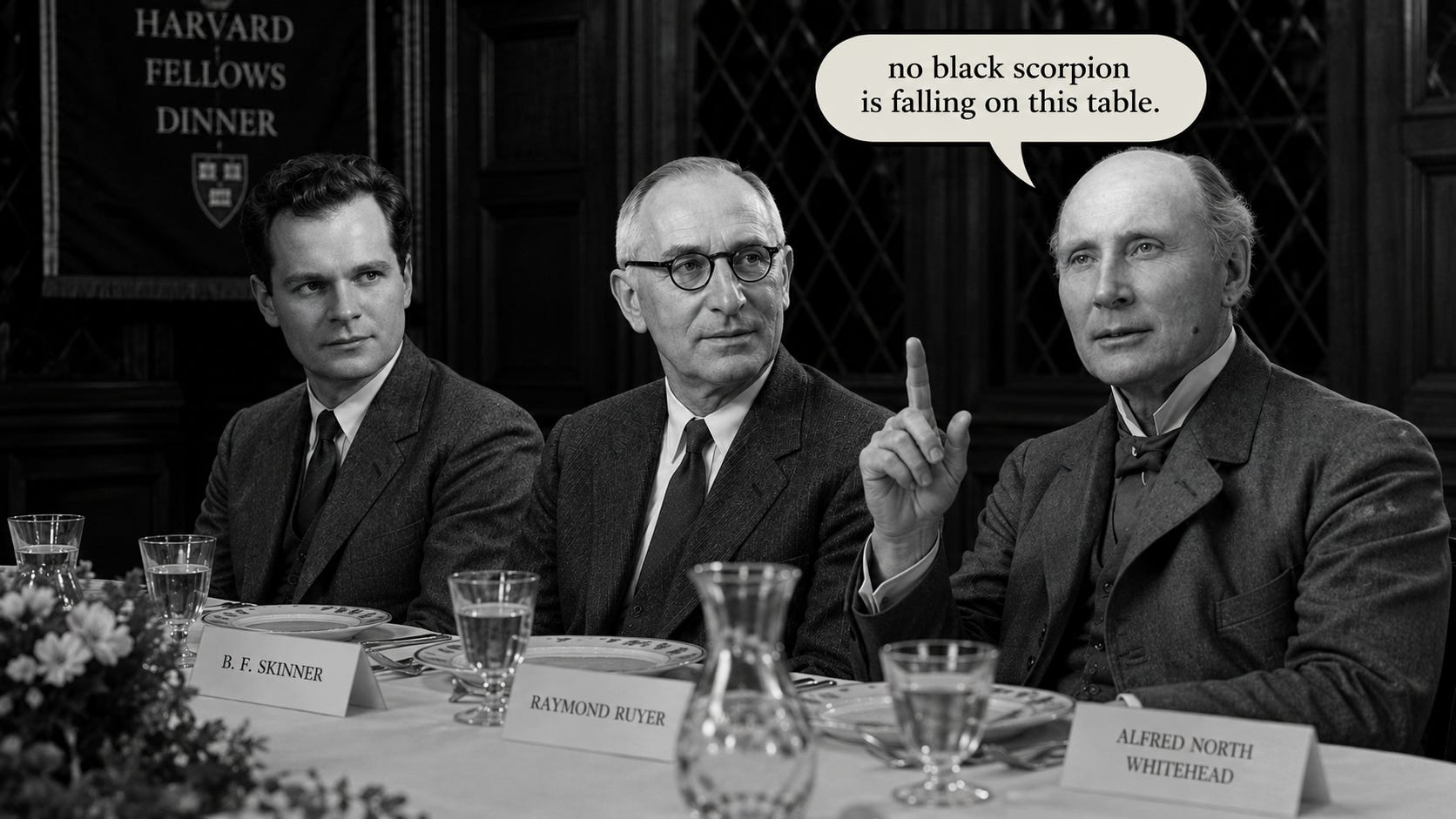
While careful to acknowledge the tremendous practical and theoretical potential of cybernetics, Ruyer goes to work with surgical precision to deny its overreaches. He helps us keep open a question that is easy to forget today, when so much energy—intellectual energy, and literal electricity—is focused on whether faster and faster processing of more and more information might somehow cause consciousness to emerge from the furious calculating of giant data centers. Ruyer’s question concerns the origin of information. Where does it come from? Like Whitehead, Ruyer had to struggle against the behaviorist tide of his time, which had laid the groundwork for the later computer model of the mind. In the ordinary psychological sense, to communicate is to convey meaning to another conscious being who interprets it. Apprehending the meaning is the end, and the transmitted pattern is the means.[10] Impatient with anything it could not observe, behaviorism had taught a generation of psychologists to dismiss the “black box” of consciousness and attend only to behavior and its effects, such that the meaning of a message came to be identified with nothing other than the set of further behaviors it triggers. Consider, for example, B.F. Skinner’s account of language as verbal behavior shaped by reinforcement, which Whitehead explicitly challenged.[11] Once meaning had been redefined as the effectuation of a physical action, the doorway to mechanizing the mind was flung wide open for functionalists, since what is physical can be measured and calculated. The semiotic aspect of information was reduced to its countable physical outputs and thus became computable. Machines could then be said to “communicate” only because communication had been emptied of everything that escapes mechanization.
It might be objected that the computational theory of mind triumphantly succeeded behaviorism in the 1960s precisely by prying open the black box. Thinkers like Hilary Putnam and Jerry Fodor sought to refute behaviorists by emphasizing the holistic structure of networks of beliefs, such that no belief issues in behavior except in concert with other beliefs and desires; thus, internal states cannot be reduced to physical outputs but must be defined in terms of their functional role in the network.[12] But functionalism opens the brain-box only to fill it with smaller boxes, reducing each neuron to a logic gate, a network node whose only relevant role is its input-output transfer. Each neural cell’s living self-surveying interiority is bracketed exactly as behaviorism had bracketed consciousness. Functionalism’s signature doctrine of multiple realizability—that the same mental state may be realized in any substrate—makes neurons entirely exchangeable with transistors. In Ruyer’s terms, computational functionalism still mistakes an external assembly of causes linked step by step with a self-surveying form, whose unity will never be visible to an external observer.[13]
Ruyer resists functionalist reductionism by insisting on a distinction between syntactical patterns and the meanings they bear, a distinction that John Searle, coming from another lineage entirely, also affirmed. According to Searle, a rule-following system that manipulates symbols, no matter how fluently, has no semantic comprehension of the syntax it trades in. Such systems lack “intrinsic intentionality,” which is distinct from the derivative intentionality of sentences and transistor circuits.[14] Claude Shannon’s celebrated theory measures information without regard to meaning, as the surprisal or statistical improbability of a signal, or more generally, as the reduction of uncertainty its successful transmission produces at the receiving end of a channel.[15] The theory concerns only the physical pattern and says nothing whatsoever about what, if anything, the pattern means. The semantic content of information falls entirely outside the theory, on Shannon’s own insistence. As Luciano Floridi captures the controversy, the issue is
“whether there can be information without an informee, or whether information, in at least some crucial sense of the word, is essentially parasitic on the semantics in the mind of the informee.”[16]
The confusion arises when Shannon’s purely and explicitly syntactic measure is smuggled into philosophy of mind as an explanation of meaning, when in reality it presupposes, at both ends of the channel, a conscious sender and receiver capable of interpretation. A string of maximal Shannon information amounts to mere noise. Meaning is not reducible to syntax but is what syntax is abstracted from.
Ruyer builds on the founding cybernetician Norbert Wiener’s admission that no operation a machine performs upon a message can increase the quantity of information that message carries from its source. Machines can store, transmit, copy, route, and amplify the signal carrying information, but they cannot themselves originate information. Ruyer grants that information machines, unlike heat engines, need not necessarily degrade what they convey. A signal can be amplified and error-corrected with complete fidelity; but “reproducing or amplifying a pattern does not increase the information itself.”[17] He calls this “the principle of the conservation of information,” according to which there is never more information in a computer’s output than was present in the input. A computer “can no more freely create information than a simple machine can freely create work.”[18] Wiener’s own admission should have prevented the over-extension of the cybernetic method into a metaphysics of life and mind. If machines cannot originate information, and if living and thinking organisms are nothing but exceptionally elaborate machines, then where could the meaning saturating our shared world have come from? The world-picture produced by cybernetics leaves us with a universe of message-passing populated entirely by machines incapable of authoring or interpreting a message.
The invention of the LLM may at first blush appear to refute Ruyer’s argument. The last several years have witnessed the development of “AI agents” that can, indeed, send, receive, and return emails ad nauseum. But we must look more closely. Ruyer deployed the image of a telephone receiver:
“A telephone receiver can no more start to talk on its own than a wheel could start to move on its own simply because it has been attached to an axle. Similarly, it would be impossible to send a telephone message by automatically sending an emission of ‘static’ that would progressively transform itself into a message at the receiving end, just as it would be impossible to set a boat in motion on the sea by relying on the lucky coincidence that the water molecules striking the stern of the ship would do so at a speed that was constantly greater than those striking the bow. … But it would be unwise to rely on these kinds of fluctuations to produce a message or to travel across the ocean. Travel requires coal or oil. … To send a message, an information machine, admirable though it may be…needs human beings to feed it, that is, to provide it with messages to transmit. If these human beings were of the same type of machine as those they were feeding, if they could not create information, we do not understand how messages could be sent.”[19]
The telephone is all relay and no source. It presupposes, at both ends of the line, the conscious beings between whom it conveys what it can neither author nor comprehend. To imagine that machines generate their own meaning is to imagine perpetual motion, and that is precisely the fantasy at the heart of the dream of artificial general intelligence and conscious machines. The LLM is a magnificent relay, a semantic conveyor belt of unprecedented power. Its fluency of transmission and recombination is entirely real but entirely derivative. It can assemble combinations not specified in its training data, thus generating novel patterns. But novelty of pattern is not origination of meaning. Of course, as enculturated beings, our own creativity also has a recombinatory element. We speak the language we inherit. Yet for Ruyer even the most unassuming human whisper is more than a relay, since:
“inspiring themes have contributed to the elaboration of the message in a quite particular manner. The ‘I’ is not an absolute origin, but neither is it a simple organ of transmission. In the elaboration of even the most unassuming message, one can clearly see that it is not simply a matter of allowing the brain to function; it is also about inserting into space (and giving to the machines functioning in that space) a ‘supply’ [aliment] that cannot simply be taken from another part of space.”[20]
Each thread of meaning, each novel contrast, is spun by and through the subjective immediacy of our valuations, whereas the fragments of syntax trafficked by the LLM were authored elsewhere and else when by the living minds who composed its training corpus. Semantic information was in us before it became syntax in the machine. And the machine, far from creating meaning, can only conserve, recombine, and—as has been made clear by the way a model collapses when trained on its own synthetic exhaust—ultimately dissipate it.[21]
But cybernetic enthusiasts may still object. Wiener cites Erwin Schrödinger’s famous text What Is Life? (1944) to argue that organisms are not closed to energy flows but thermodynamically open.[22] The universe as a whole may tend toward dissipation, but given the proper conditions, local regions can increase order by exporting disorder to their surroundings, as when a crystal grows in solution, or a refrigerator hums in the kitchen. Life, on such accounts, is just such a local eddy of mounting order, feeding, as Schrödinger put it, on “negative entropy,” which Léon Brillouin and Wiener then equated outright with information.[23] There thus need be no deep mystery in life’s persistence or in the information it accumulates. Ruyer was perfectly willing to grant the physics of open thermodynamic systems, but the cybernetic argument trades on an equivocation in the definition of “order.” Negentropy is a quantitative notion, while order and meaning are qualitative; in most cases there is simply no measure by which one system counts as “more ordered” than another.[24] Physics can indeed explain the emergence of the homogeneous, repetitive order of a crystal lattice or a convection cell. Schrödinger himself partly recognized the difficulty when he distinguished ordinary periodic crystals from the “aperiodic crystal” of hereditary material, whose irregular molecular arrangement could carry a biological “code-script.”[25] Yet aperiodicity alone does not explain functional or meaningful organization. And the phrase “code-script” already smuggles in what it claims to explain, since a code is never self-interpreting but presupposes a reader who grasps what the cipher is for. Ruyer rejects as a Laplacian dream the theory that organic development is be “programmed” by a genetic “code.” Genes are not patterns that transfer their order to the macroscopic organism but physical “modulators” of trans-spatial thematic meanings or lures.[26] The irregular sequence of an aperiodic crystal may be physically stable and informationally specifiable without thereby being capable of determining the melodic development of an embryo, just as an LLM’s string of tokens may carry statistically probable arrangements of words without it thereby being capable of comprehending the meaning of a sentence.[27] What remains unexplained is heterogeneous order: the coordinated arrangement of non-interchangeable parts whose significance derives from their role within the integrated wholeness of a living organism. To expect such meaningful molecules to assemble themselves out of random fluctuations, even in an open system with a voracious appetite for negative entropy, is as miraculous as expecting a coherent sentence to condense out of the static on an open telephone line. Ruyer quips:
“The ‘stored’ program of genetics is like a book that everyone swears is extremely interesting, but that no one has ever been able to read, and of which it could be proven that no one could ever read.”[28]
Cyberneticians may further object that organisms are not the product of random fluctuations but the cumulative achievement of the slow ratcheting process of natural selection, whereby heritable variation and differential survival manufacture functional order with no author required. But on Whitehead and Ruyer’s panexperiential reading, natural selection cannot itself be the ground of meaningful evaluation, because it already presupposes it. The strict neo-Darwinian may object that appetite and preference are themselves late products of selection; yet selection can sort only among variants that already strive, and even the most primitive striving is already valuation in nuce. If evolution exemplifies the urge not merely to survive but to thrive, to intensify aesthetic satisfaction, then variation and selection are not just blind statistical mechanisms alone but expressions of a cosmic eros. Aims and appetites for this over that are already astir in the humblest bacterium’s preference for yum over yuck. Selection does not conjure value-experience out of vacuous matter, it redistributes value-laden variations, sorting among strivings always already underway. It can prune but it cannot produce the aims of organisms. Like fanciful metaphorical appeals to a “genetic program,” the appeal to selection assumes the purposiveness it claims to have constructed. Far from explaining the origin of meaning, the Darwinian principle of natural selection silently helps itself to it, just as the cybernetic theory of life and mind helps itself to the semantic information its machines merely transmit.
Communication is never the mere transmission of data, of physical patterns, but always an expressive and interpretive participation in meaning. Information is not a fixed pattern handed from sender to receiver who passively reproduces it. The sender does not begin with a string of symbols and then assemble them into a message. She begins with a more or less vague sense of meaning, a “theme” in Ruyer’s sense, “composed of suggestions and possibilities,”[29] grasped as a living but inchoate whole, which then summons the words and sentences that will convey it. The listening and reading of the receiver are no less creative, for the one who comprehends is not passive wax imprinted with a seal but must express the theme in his turn, from within his own center of valuation. The frozen weights of an LLM, in computing the statistically probable next token, perform no such evaluation. They prehend no theme, because there is no one on the line for whom a theme could be meaningful.
Again, none of this is to say that we should smash the looms, or that automated computation is not in some sense inevitable given the evolutionary trajectory of media technologies. Despite lacking consciousness of their own, they are already irreversibly transforming ours. Ruyer himself distinguished between what he called “ambitious cybernetics” inflated into a totalitarian mechanist metaphysics, and “effective cybernetics,” or “pure technics stripped of its pretensions.”[30] He already in the mid-twentieth century the rapidly growing imbalance between the naked human brain and the sheer accumulated weight of the information produced by civilization. The brain “is too weak to bear the weight of the enormous amount of information accumulated in libraries through printing,”[31] and certainly far too weak to bear what has since accumulated on the Internet. The modern explosion of recorded knowledge has overwhelmed the unaided mind. But a wise engagement with LLMs and their descendants might allow them to function more as electronic amplifiers of human thought, rather than as amputators. Ruyer held out hope that the cybernetic age would liberate rather than replace human thinking, freeing the human brain “just as high-powered machines have begun to liberate human muscles,” and freeing us “from everything that is ‘slavish’ in the work of surveillance or control.”[32] We may, he hoped, leverage the power of automated computation to expand the leisure time available for self-cultivation, thereby granting the “enlarged body” of our technological civilization what Bergson called a “supplement of soul.”[33] Restored to the commons and stripped of its metaphysical pretensions, automated computation can be what Ruyer said effective cybernetics really is: an “auxiliary of life and conscious intention,” indissociable from both.[34] As a prosthesis of the Understanding, LLMs and other technologies of automated computation can extend rather than extinguish human thinking, taking up the crushing burden of accumulated information so that speculative Reason is freed for its proper flight. Human souls are not an obstacle to machine super-intelligence to be engineered out of the loop but the very condition of that intelligence’s significance. Keeping the human in the loop is therefore not romantic sentiment but sound metaphysics: we are the mediators of meaning between machines, the living centers of valuation through whom alone their tokens partake in mind. [35]
[1] Raymond Ruyer, Cybernetics and the Origin of Information, trans. Amélie Berger-Soraruff, Andrew Iliadis, Daniel W. Smith, and Ashley Woodward (Lanham, MD: Rowman & Littlefield, 2024 [1954]).
[2] Ruyer, Neofinalism, 86.
[3] Whitehead, Process and Reality, 29.
[4] Whitehead, Process and Reality, 85-86.
[5] Ruyer, Neofinalism, 92.
[6] Ruyer, Éléments de psycho-biologie (Paris: Presses Universitaires de France, 1946), 4, 18–19.
[7] Whitehead, Process and Reality, 283; Ruyer, Éléments de psycho-biologie, 16.
[8] Ruyer, Éléments de psycho-biologie, 20.
[9] Ruyer, Éléments de psycho-biologie, 5.
[10] Note that this naïve psychological understanding of communication is complicated by an understanding of the constitutive role of media technologies in all communication. As McLuhan made clear, media are never neutral carriers of preexisting content. Every medium brings with it a distinctive form, rhythm, and sensory re-organization that profoundly conditions what can be communicated, how it is received, and even what may count as meaningful in the first place. Hence McLuhan’s famous dictum: “the medium is the message.” See McLuhan, Understanding Media: The Extensions of Man (New York: McGraw-Hill, 1964), 7.
[11] B. F. Skinner, Verbal Behavior (New York: Appleton-Century-Crofts, 1957). Skinner concludes his book with an anecdote about dining with Whitehead at Harvard in 1934, who had attempted to refute Skinner’s behaviorism by defending the imaginative freedom exhibited by human speech: “‘Let me see you,’ he said, ‘account for my behavior as I sit here saying “No black scorpion is falling upon this table.”’ The next morning I drew up the outline of the present study” (457).
[12] Hilary Putnam, Mind, Language and Reality: Philosophical Papers, Vol. 2 (Cambridge: Cambridge University Press, 1975); Jerry Fodor, Psychological Explanation: An Introduction to the Philosophy of Psychology (New York: Random House, 1968). On functionalism’s emergence as a critique of behaviorism, see Ned Block, “Introduction: What Is Functionalism?” in Readings in Philosophy of Psychology, Vol. 1 (Cambridge, MA: Harvard University Press, 1980). Note that Putnam himself later repudiated functionalism in Representation and Reality (1988).
[13] Ruyer, Neofinalism, 60.
[14] John Searle, The Rediscovery of the Mind (1992), 3: “A dominant strain in the philosophy of mind and cognitive science has been to suppose that computation is an intrinsic feature of the world and that consciousness and intentionality are somehow eliminable, either in favor of something else or because they are observer relative, or reducible to something more basic, such as computation. In this book I argue that these suppositions are exactly backward: Consciousness and intentionality are intrinsic and ineliminable, and computation—except for the few cases in which the computation is actually being performed by a conscious mind—is observer relative.”
[15] Shannon, C. and Weaver, W. The Mathematical Theory of Communication (University of Illinois Press, 1949).
[16] Luciano Floridi, “Open Problems in the Philosophy of Information,” Metaphilosophy 35, no. 4 (2004): 554–582, problem 16.
[17] Ruyer, Cybernetics and the Origin of Information, 7.
[18] Ruyer, Cybernetics and the Origin of Information, 5-7.
[19] Ruyer, Cybernetics and the Origin of Information, 7.
[20] Ruyer, Cybernetics and the Origin of Information, 5.
[21] Ilia Shumailov et al., “AI Models Collapse When Trained on Recursively Generated Data,” Nature 631 (2024): 755–759, https://doi.org/10.1038/s41586-024-07566-y.
[22] Wiener, Cybernetics: Control and Communication in the Animal and the Machine (MIT Press, 1948), 18-19. See also Daniel Nicholson, What Is Life? Revisited (Cambridge University Press, 2025), 53.
[23] Léon Brillouin, Science and Information Theory (New York: Academic Press, 1956); Norbert Wiener, Cybernetics (1948).
[24] This formulation follows Georges Chapouthier’s reading of Ruyer, cited in the Translator’s Introduction to Cybernetics and the Origin of Information, xxi; Chapouthier identifies the conflation of negentropy, order, and information as one of the chief errors of twentieth-century biology, attributing the confusion in particular to Léon Brillouin. See also Ruyer, Cybernetics and the Origin of Information ,169, 174.
[25] Schrödinger, What Is Life?, 20, 61. Quoted in Nicholson, What Is Life? Revisited, 27.
[26] Ruyer, Cybernetics and the Origin of Information, 89.
[27] Nicholson elaborates upon the failures of the idea that such an “aperiodic crystal,” later christened as the genome, could “compute the embryo”: “The information required to specify an organism does not come preformed in the DNA. It emerges progressively through the interaction of DNA with other cellular components, as well as with the environment. Development is not the gradual unfolding of the organism from a prespecified genetic plan. It is a highly dynamic and heterogeneous process of construction involving the confluence of numerous interacting causal factors, only some of which have their basis in the DNA. … It is difficult to see how genes could possibly be responsible for initiating, directing, and controlling development, given that DNA is not an inherently active molecule, but rather requires activation from without. By itself, DNA is inert, relatively unstructured, and non-functional. To be functional, it needs to be embedded in an already organized, living cell” (What Is Life? Revisited, 29-30).
[28] Ruyer, Cybernetics and the Origin of Information, 174.
[29] As his translators glossed it. See Ruyer, Cybernetics and the Origin of Information, xiii.
[30] Ruyer, Cybernetics and the Origin of Information, 137.
[31] Ruyer, Cybernetics and the Origin of Information, 8.
[32] Ruyer, Cybernetics and the Origin of Information, 8.
[33] Bergson, Two Sources of Morality and Religion, 268. Quoted by Ruyer, Cybernetics and the Origin of Information, 8.
[34] Ruyer, Cybernetics and the Origin of Information, 138.
[35] Gilbert Simondon, who judged Ruyer’s work on cybernetics indispensable, saw more clearly than both cyberneticians and their critics that technical objects possess their own mode of existence and genesis. Machines are not a merely inert instruments but processes of individuation. To grant this is not to concede machine subjectivity. Technologies of automated computation realize a genuine technical individuation but nonetheless lack a presiding occasion of their own, and so depend on human beings to stand between their circuits as the mediators of their meaning. See Ashley Woodward, “Philosophy of/as Information,” 219.
I really do thank you for being such a dedicated worker. I am grateful.
As a doctoral student, I began to study Ludwig von bertalanfy. Family systems thinking. Skinner’s book beyond freedom and dignity. And many many many other perspectives. Right now I am landing with you and McGilchrist. And Tripp Fuller. Ilia Delio. And through many years and many miles, I arrived at being a grandmother. That is when my heart broke open again to the love as the driving force in the center of the universe. Bryan swim has been a teacher of mine. And Thomas Berry. so, I would actually like to have a conversation with you one day. I said that a year or so back and you invited me to be in touch. But meanwhile, your website sent me off into cyberspace because I was not a student. But I am a student. Even at age 82, I am opening myself to these new dimensions. Best expressed by all the people I mentioned above and Bill Plotkin. I highly recommend going on the Animas Valley Institute. What he is writing for the newsletter is very powerful. He also has a very good interview Online with Brian Swimme. He is talking about Soul initiation. And his work is very rich. I would love to talk to you one day. If you can help me get around your fire walls blessings in all that you do. I look forward to hearing from the rest of your journeys. My dream last night showed me making peace, talking lovingly to three different aspects of my animus. Interesting. I am now in relationship with the beloved of my soul. He and I both did the possible human training with Jean Houston from 1982 to 1985. It is fascinating to see that we have grown apart and together. And Jean has seated us all for becoming cosmic butterflies. As she said at the end of her life. Her memorial is on the website for unity of Ashland Oregon. It is quite beautiful. Love your work. I have adopted you as my grandson.