
Why Natural Science Would Be Better Off Without Physicalist Metaphysics
Reflections after my chat with James Faulk

I enjoyed my chat with James Faulk the other day. Here’s the video:
I had a mustache for like 5 minutes a few years ago. I have had to accept that online the stache may be restacked forever.
Anyway. Here’s a recap of what was basically a long argument about why natural science is not equivalent to physicalism.
Science Is Not Physicalism
There is a lot of conflation of science with physicalism, which is a particular metaphysical interpretation of scientific evidence. Much of the excitement nowadays in consciousness studies and philosophy of mind is around the reevaluation of that simple equation between what science says, in terms of empirical evidence and the best working models across physics and biology, and what sort of philosophical and metaphysical interpretation we can give that science.
Philosophy of science 101: correlation is not causation. It has been very well established that there are complex correlations between reported experience and brain activity. But neural correlation does not by itself settle the causal or ontological relationship between brain and consciousness. The brain is not a simple storage device in which each memory is filed away in a discrete location. Memory and perception are distributed, dynamic, and context-sensitive. Yes, there are sometimes powerful correlations, but they do not amount to an explanation of how matter, conceived as vacuous stuff, could give rise to the multifarious forms of experience we encounter each day and night.
The gap is the result of a mode of thinking that goes back several hundred years to Descartes, who distinguished between res extensa, extended substance, and res cogitans, thinking substance. Most neuroscientists would reject Cartesian dualism, but many still inherit the Cartesian understanding of matter and subtly presuppose a Cartesian understanding of mind. Science is imagined as if it were done from a neutral outside perspective, as if a mind was looking in at nature to measure and decode its mechanisms. So while Cartesian dualism is often explicitly denied, it continues to be tacitly performed in the way research claims are made. Who is the epistemic subject that claims to know that consciousness is really just functional software running on neural hardware? You cannot reduce knowledge to neurology (with neurons conceived as electrochemical machines programmed by selfish genes designed by a blind watchmaker) and still claim scientific neutrality. We need a more biologically realistic onto-epistemology! Mind is embodied, knowledge is inseparable from (inter)being, and so knowing is participatory rather than representational. The effort to know is not the story of a separate subject trying to build a more accurate internal model of isolated objects housed in some foreign dimension out there.
In many physicalist theories of consciousness, mind is treated as epiphenomenal. The smoke above a steam engine. All effect, no causal power. We delude ourselves into believing we think, feel, and will (an evolutionarily advantageous conjuring trick invented by our profit-seeking genes!), but really, on the physicalist picture, beneath our skin there’s nothing more worth knowing about than the laws of physics (Sean Carroll’s Core Theory t-shirt). We are left with an absurdist horror movie, watching it happen, imagining we are involved. A hallucination controlled only by our ancestors’ adaptation to conditions that got most everyone else killed.
There is suggestive psychological research on the downstream effects of this kind of physicalist story. Vohs and Schooler’s 2008 study found that inducing disbelief in free will increased cheating (admittedly, as with most psychological research, later replication difficulties has stirred plenty of controversy). A single study can’t settle this question, of course. But it should be no surprise that the stories we tell about agency could have real psychosocial consequences. Culture shapes the sorts of questions science tends to ask, and how it asks them. And the way novel scientific discoveries are communicated reshapes culture in turn.
Our culture is in the midst of a meaning crisis. A flat materialist interpretation of science leaves people feeling that we do not belong in this universe, that values and feelings are a sideshow, and that what is really going on is just electrochemistry in an apex predator brain. The whole earth is just a big brain-in-a-vat, a mote of dust floating in a vast meaningless space. Sure , a thin film of bioplasm swarms on the surface. But it will soon be swallowed by our Sun, our gaseous dying god, as it expands into earth’s orbit. Physicalist are not without wonder in the face of such cosmic conflagrations. But I worry in their glee to heroically explain away cosmic purpose that a kind of metaphysical horseshoe theory becomes operative. They champion the Big Bang story about how everything comes from nothing, but I am increasingly suspicious of growing holes in its evidentiary basis and logical incoherence. The laws of physics and the dimensions of spacetime pass beyond their limits and melt into incoherent goo in a singularity. How are we to understand that time might have a beginning? Is that even a thinkable thought? And the “nothing”—the “no reason!” from which everything is supposed to have accidentally come, it turns out, has to be given a ton of complicated, finely-tuned mathematical features. It should be no surprise that Intelligent Design theorists are absolutely in love with Big Bang theology!
The point is not just to recover a sense that human life is immersed in mystery. That is a good start. But we also have to wake up from the nightmare of anthropocentrism. Modern materialism has convinced us to imagine that all the meaning and value in the universe is made up inside human heads. What hubris! It is not just that we are wrapped in mystery, it is that there is real meaning to be discerned in our study of the heavens, and real ecological values that we have a responsibility to protect and further on this earth. The materialist story leaves us lonely and alienated, cut off from the real meanings and values of a living world. This has destructive social effects. It is also destroying the life systems of this planet.
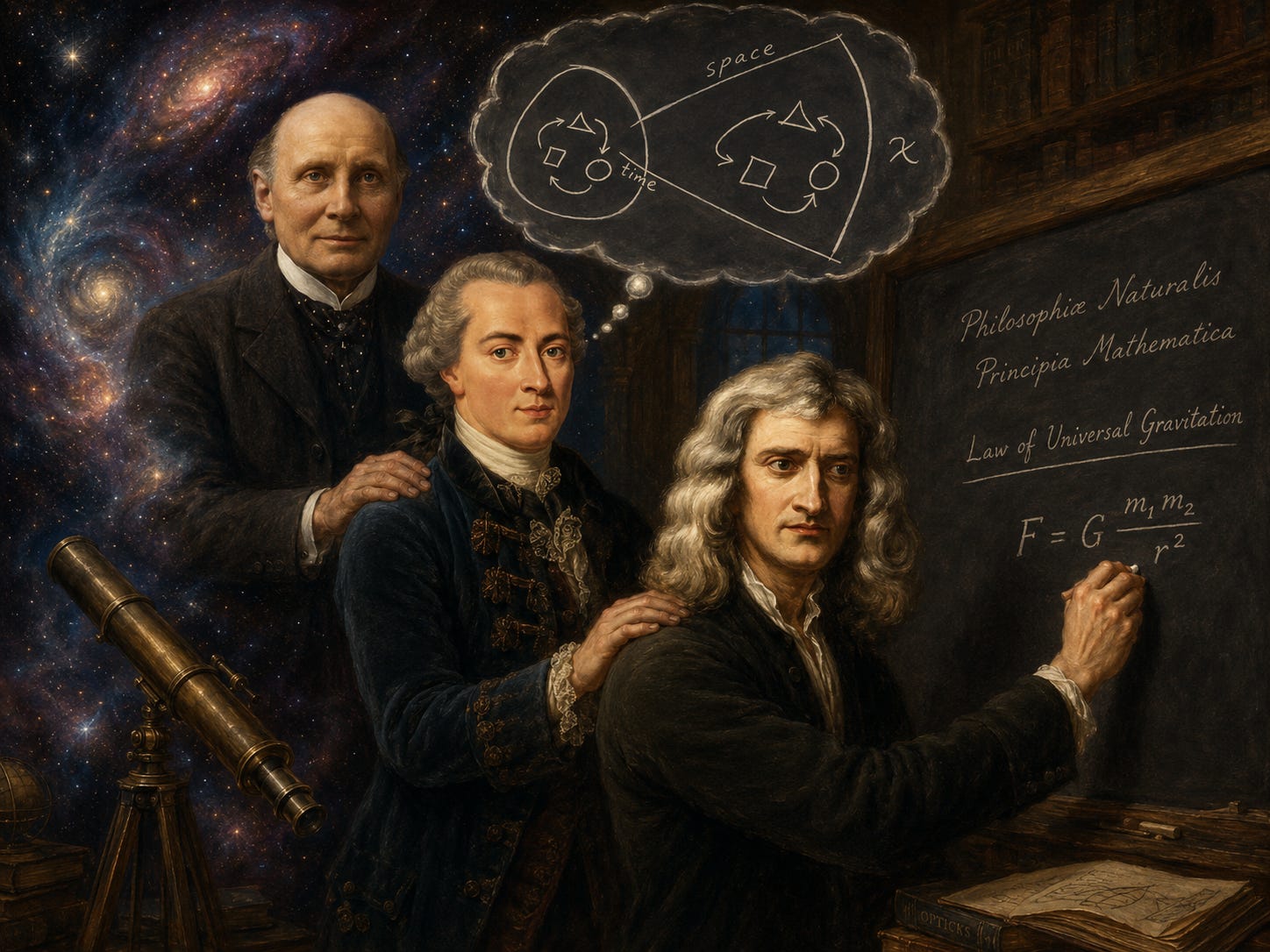
When engaging with physicalists who claim consciousness is nothing special—that it is just another biological trait excreted by the brain once brains became complicated enough—I often dress up as a transcendental idealist to start. Kant argued that physical laws are not simply discovered “out there” in nature. They reflect the structure of human understanding. Space and time are not learned by abstraction from physical objects. Rather, our experience of objects already presupposes the spatiotemporal structure of our own perceptual organization.
But Kant is a halfway house. He shows the meta-epistemic impossibility of physicalism, but he does not reconnect us to the cosmos. The thing-in-itself remains an unexplained X. The cosmos becomes an appearance determined by human cognition. I do not find that finally satisfying. Nor do I want to go to the opposite extreme and say everything is One Big Mind and all individual body-minds are illusions. That is just another form of reductionism. Bodies are real. Otherness is real. A plurality of perspectives co-creates this universe, this pluriverse. Whether there is one mind to which we all belong is not something I dismiss, by any means. But I would say that sort of holism could only ever be a partial truth, lest it become reductive holism. We have to proceed with more caution lest our zeal for nondualism do real violence to the multifariousness of (co)existence.
This is where I have reservations about Bernardo Kastrup’s analytic idealism, even if I find parts of it compelling and would want to affirm the cultural significance of his popularity. Panpsychism and idealism are becoming more respectable, both in academia and among the general public. This despite the bitter protests of physicalists, who sometimes behave like inquisitors excommunicating heretics. Still, when it comes to monistic idealisms, I resist the idea that our individual perspectives are illusions or merely dissociated fragments of one mind. I cannot shake the intuition that there is something about the essence of reality that requires real relationship between distinct beings. Distinct does not mean separate and isolated. But if the divine mind individuated, there must be something about embodiment that the divine found infinitely valuable. It may turn out to be only a subtler form of egoism to say, “I have to get out of this me-mirage and return to the one mind!” While I’m all in favor of deflating narcissistic egoism, I worry about how the urge to merge may end up adding more hot air. The question I can’t help asking is: why did the one mind want to become you?
This wouldn’t be a proper anti-physicalist mini-manifesto without a pinch of quantum woo. Quantum physics, whatever else we may say about it, definitively undermines the mechanistic image of nature. Bohr, Heisenberg, Schrödinger, Pauli, and others recognized that quantum theory could not be comfortably housed within the old Newtonian-Cartesian metaphysics that had undergirded modern science since its inception. Entanglement, nonlocality, and probabilistic behavior do not cohere with the old clockwork picture. Yet the predictive power of the formalism so outran our understanding that, a century later, there is still no consensus on what quantum physics means about reality. “Shut up and calculate” isn’t just a method, it’s a mood.
The danger is that serious interpretation of the quantum measurement problem gets marginalized, while the quantum vacuum fills with “the secret” that “you create your own reality”! What the Bleep Do We Know?!, and so on. Neither positivist silence nor New Age projection will do any longer. Physics needs a new philosophy of nature, a new onto-epistemology, a new way of doing autocosmology.
Quantum mechanics should really be called quantum organics. That was Whitehead’s view, at least. We need to let biology teach physics a new science. Biology is historical, contingent, variable. There are not “laws” of biology in the way there are “laws” of mechanics. Every organism is unique, with every lineage inheriting not only genes but niches, learned behaviors, and a whole variety of varying enabling and disabling relations. Physics, by contrast, treats every electron or hydrogen atom as identical for the purposes of equations. That assumption works extraordinarily well at certain scales and levels of abstraction. But metaphysically, what if this abstract identity is a simplifying abstraction fit for modeling but entirely misleading as an imagine of is really going on in nature?
Whitehead would say that particle physics studies smaller organisms and biology studies larger ones. The whole history of the universe is evolutionary, and what we call laws of physics are emergent habits stabilized over cosmic time. If physical law is imagined as fixed, eternal, and imposed from outside the universe, the door opens to intelligent design and fine-tuning arguments. If we want to avoid that god-of-the-gaps picture, we need to historicize physics, not only biology.
Concluding Crumb Trails for Further Inquiry into Consciousness
Philosophers should not pretend to be scientists, but nor should they refrain from criticizing the abstractions of the special sciences. A molecular biologist enchanted by genetics may inflate the selfish gene hypothesis into a master theory of life. But what about niche construction? Developmental plasticity? Learned behavior? Ecological inheritance? Philosophy helps us move between models without being captured by one.
The history of science is also important. The scientific revolution was not a simple war between science and religion. Copernicus’ elaboration of heliocentrism was entangled with ecclesial concerns about the astronomical accuracy of its liturgical calendar. History is messier than the overplayed science vs. religion polemic allows.
Returning again to brain/mind relations, from a Whiteheadian perspective, each cell is itself a center of experience. The brain is a complex community of sentient processes coordinating perception and action. This lends itself to a Jungian or Hillmanian view of the psyche as plural: a miniature pantheon of archetypal complexes. The ego is not master of its house. The unconscious is not the absence of experience, but other modes of consciousness not identical with ego-consciousness.
For the brain–mind relation, the better analogy may be the brain as antenna or filter. We are immersed in a field of feeling, and the nervous system filters, receives, amplifies, and coordinates what is relevant for our specific form of life. The brain is necessary for our kind of consciousness, but not sufficient to produce consciousness from scratch. As Iain McGilchrist, drawing on Bergson, James, and Whitehead, puts it: the brain permits consciousness, but does not produce it.
Human consciousness is only one mode among many. There is no single measure of “consciousness,” even among humans. What counts as consciousness is like what counts as intelligence: it depends on the organism, the environment, and the task at hand. Rupert Sheldrake’s question “Is the Sun Conscious?” is provocative in exactly the right way. If consciousness is associated with complex electromagnetic activity, then asking if the Sun—a vast, massively complex electromagnetic plasma system—is consciousness is not an idle irrelevance. We need not dogmatically affirm solar minds to see that panpsychism or panexperientialism reopens possibilities prematurely closed by materialism.
Loved it! Thank you for writing this. Reminded me of this passage of Whitehead:
"Many a scientist has patiently designed experiments for the purpose of substantiating his belief that animal operations are motivated by no purposes. He has perhaps spent his spare time in writing articles to prove that human beings are as other animals so that 'purpose' is a category irrelevant for the explanation of their bodily activities, his own activities included. Scientists animated by the purpose of proving that they are purposeless constitute an interesting subject for study."
That self-undermining irony is exactly what you're circling throughout your essay, the epistemic subject who claims to have dissolved the epistemic subject... The researcher who uses reason, curiosity, and intention to argue that reason, curiosity, and intention are epiphenomenal noise. The whole edifice collapses under its own weight, and yet it continues to be performed, as you note, with the confidence of someone who has forgotten they are standing on a philosophical floor they did not build.
I appreciate the bit about science necessarily operating within a philosophical framework — that even the idea of being “neutral”, whatever that means, is itself a philosophical position. It reminds me of Kafka’s ‘The Investigations of a Dog’. Found it illuminating upon analysis, because fundamentally the story is an examination of how our intellectual frameworks and underlying assumptions shape and limit the kind of knowledge we produce, questions we pose, and therefore, the kind of reality we construct. It’s a great piece, I recommend it :)
Also, kastrup’s analytic idealism was one of my first introductions to idealism. I found it to be fascinating but like you had my reservations. What I found interesting recently (and what you may too) is in one of his weekly meetings he addresses the notion of “seeing without eyes” — people reporting seeing their body from the third person, confirming conversations or whatever else whilst clinically dead. If we take this on face value, it’s not just that they “know” what took place in the room, it’s that they *saw* what took place. Using kastrup’s analogy, that’s seeing the dials moving on the dashboard itself whilst being outside of the plane! That’s strange! And if true, definitely poses a threat to his thesis.
Great essay:)