
The Philosophical Implications of the Second Scientific Revolution
Notes from my history of philosophy course lecture on Darwin, Maxwell, Einstein, and Bohr

I shared a revised transcript of my lecture on Leibniz and Spinoza a few weeks ago. Below I am doing the same for another lecture, this time focused on what Richard Tarnas calls “The Crisis of Modern Science” in his book Passion of the Western Mind (1991).
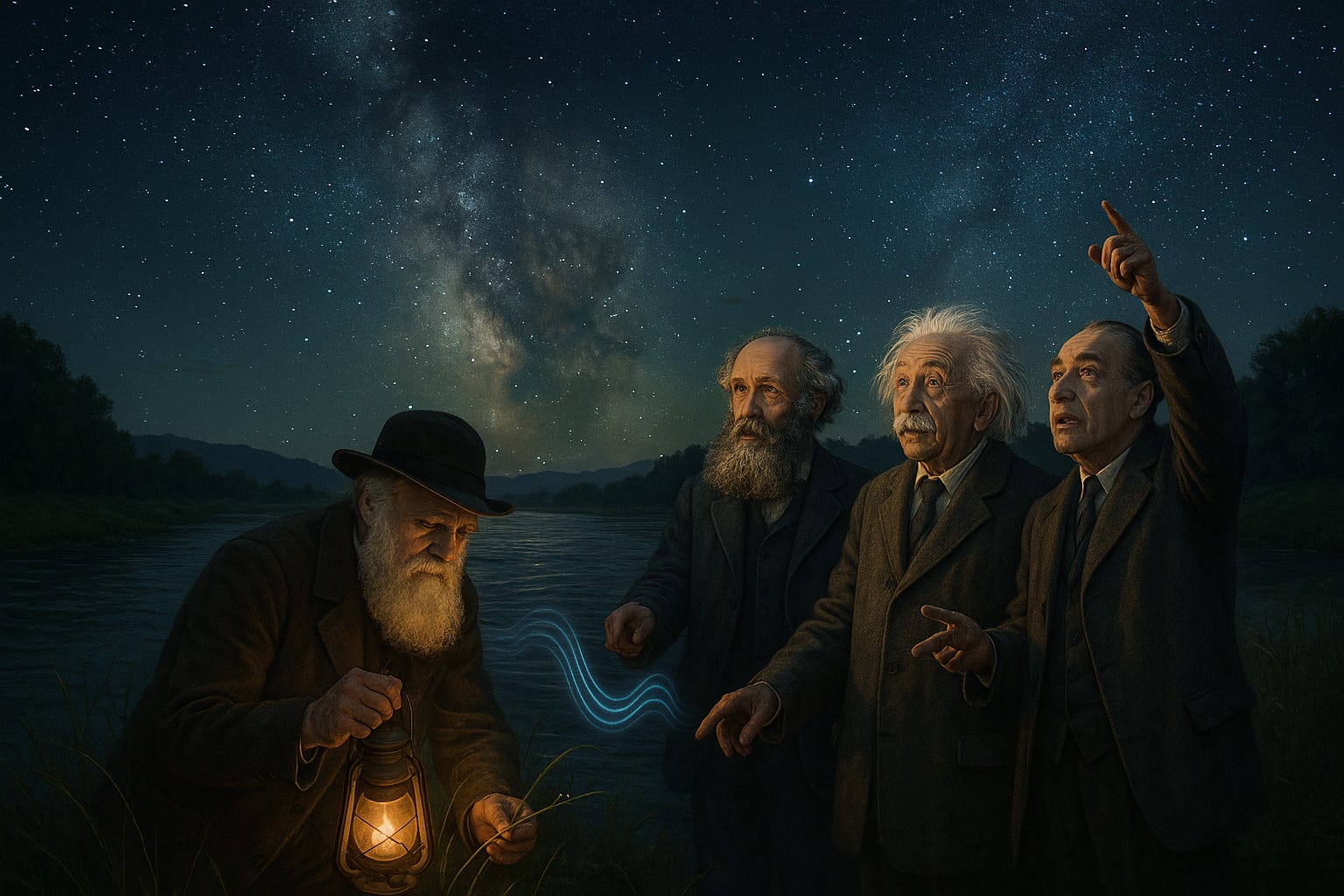
I want to frame what follows with a felt sense of the evolution of consciousness—from the Greeks to the moderns—and to situate the second scientific revolution inside that larger arc. The ancient Greek mode of attunement made ideas seem like living realities perceived in the very workings of the cosmos. Over time—beginning in the Middle Ages with nominalism and climaxing in Descartes—ideas ceased to be encountered “out there” and came to be understood as constructed “in here,” within the human mind. Kant consummates that turn: the universality and necessity of our knowledge belong, he says, to the architecture of our reason, not to “things in themselves.” Physics, on this account, becomes a project of asking nature questions whose very form is given by the forms of our intuition (space and time) and the categories of understanding.
This shift in consciousness is mirrored in science’s own self-understanding. The first scientific revolution culminates in a mechanistic picture: Newton’s clockwork cosmos, absolute space and time, strict laws yielding certainty—Laplacian omniscience about where every particle was and will be. The second revolution—roughly from the nineteenth century through the early twentieth—recasts that picture. It is not a simple replacement but a spiral: the past becomes relevant in a new way and inspires breakthroughs in the present. If Romanticism offers a road not taken, it remains relevant precisely because it can help us re-enchant what we have learned without abandoning rigor.
We move from Newton’s deterministic certainties to the statistical probabilities of thermodynamics, from particles falling in the void to continuous fields and curved spacetime, and to quanta of energy that resist simple location.
Kant’s Organism and the Limit of Mechanism
Kant’s critical philosophy sets the problem with admirable clarity. By his lights, the success of physics arises because its laws mirror the form of our own minds; Newton, from a Kantian angle, did not so much read off laws from nature as pose to nature questions already structured by reason. But when Kant turns from “the starry heavens above” to the living world, something changes. Organisms exhibit a whole-to-part causality—self-organization—that our mechanistic categories cannot capture. Hence the provocation: it is absurd, he writes in the Critique of Judgment, to expect a Newton who would render the generation of a blade of grass comprehensible from laws that no intention has ordered. We can, at best, judge as if organisms are purposive; this is a heuristic necessity of our judgment, not a law of nature in itself. Kant likens living causality to artistic genius: an intuition of the whole that governs the articulation of parts—a form of inward purposiveness irreducible to external assembly.
Darwin Between Design and Life’s Interior
Enter Darwin, often hailed—wrongly, in my view—as precisely the “Newton of the grass blade” Kant forbade. Darwin’s genius is real, but it concerns not the origin of life but the origin of species. With the powerful triad of variation, inheritance, and selection, he explains the appearance of design without invoking an external designer. Fitness here means fitting into a niche, a resonance between organism and environment, not merely survival of the “strongest.” Yet Darwin’s theory leaves untouched the difference in causality that Kant flagged. Natural selection accounts for diversification and adaptation; it does not tell us why living wholes are internally generated in the first place. The purposiveness of adaptations is explained away as an “illusion” accounted for by the “blind” process of natural selection, but the interior, self-organizing unity of the organism remains conceptually unaccounted for.
There is also the nineteenth-century tension that haunts modern thought: thermodynamics tells a story of dissipation, energy running down—order to disorder—while evolutionary biology narrates ascending complexity. Physics runs down; life, in Darwin’s vision, runs up. That split becomes especially glaring once the second law is firmly in place. More recent 20th century developments have assuaged this difficulty.
Darwin himself is morally and intellectually complex. He abhorred slavery, came from an abolitionist milieu, and affirmed the shared ancestry of all humans. Yet in The Descent of Man he also framed a hierarchy of “civilised” over “savage” peoples and even forecast that the former would “exterminate and replace” the latter—a stance that helped midwife later pseudoscientific racisms despite his anti-slavery convictions. The complexity matters. It reminds us how a reductionistic paradigm can underwrite very different moral projects—sometimes abolitionist, sometimes supremacist—while keeping intact an image of design imposed from the outside in (by God in natural theology, by environment in natural selection). Kant and the Romantics instead seek to elaborate a form of purposiveness that springs from the inside out.
Consider, too, the toll Darwin’s theory of natural selection had on his own inner life. Late in life he confessed that poetry and music had lost their savor: “My mind seems to have become a kind of machine for grinding general laws out of large collections of facts.” He feared what that atrophy meant for happiness and moral character. The Romantic view of nature animated Darwin’s youthful journeys; his classificatory machine deadened that anima.
We should also tip our hats to Alfred Russel Wallace, co-discoverer of natural selection, whose star dimmed partly because he refused the reigning materialist mythos. Wallace judged natural selection insufficient for explaining consciousness, morality, and aesthetics; he leaned instead toward a panpsychist or spiritualist sensibility—spirit and matter as two faces of one process. His refusal to treat mind as an epiphenomenon kept alive questions that mechanistic explanations bracketed or sought to explain away.
From Vacuum to Ether to Spacetime
Shifting gears from biology to physics, the break with Newtonian mechanics begins in earnest with electromagnetism. Hans Christian Ørsted’s 1820 discovery that current deflects a compass needle makes electricity and magnetism a unified polarity; Faraday, a bookbinder’s apprentice turned experimental genius, maps “lines of force” and induction; James Clerk Maxwell, a whimsical Scottish prodigy and devout Presbyterian, renders their insights into field equations. With Maxwell’s “Dynamical Theory of the Electromagnetic Field” (1865), light itself becomes an electromagnetic wave; the cosmos ceases to be emptiness plus particles and becomes a plenum of fields with energy and momentum, influences propagating at a finite speed.
Maxwell still spoke of a luminiferous ether, an undulating material medium. The 1887 Michelson–Morley interferometer found no ether wind, a null result that helped clear the stage for Einstein’s 1905 special relativity: the speed of light is invariant for all inertial observers; time dilates; lengths contract; simultaneity is relative. By 1915, general relativity curves spacetime itself: gravity is geometry, not a force. The 1919 eclipse confirmed starlight’s deflection near the Sun. The GPS in our smartphones works because they continuously apply relativity’s corrections.
Did Einstein “kill” the ether? In name, mostly. In a 1920 Leiden lecture he speaks of a “new ether”: not a mechanical substance, but spacetime endowed with physical qualities—no absolute rest, no gears or vortices, yet genuinely there as the medium of gravitational happenings. From Newton to Maxwell to Einstein, nature shifts from clockwork to field to non-Euclidean higher dimensional geometry. Predictive power skyrockets as the common-sense picture buckles. Hence the growing split we feel between the instrumental success of “shut up and calculate” and the desire for intelligibility. This is precisely where a revived Romantic thread—Schelling’s polarities, Goethe’s metamorphosis, etc.—can help re-enchant the picture without discarding the momentous progress of physics.
Einstein’s own arc illumines the hinge. His annus mirabilis yielded four papers: on the photoelectric effect (introducing light quanta), Brownian motion (bolstering atomism), special relativity (unifying space and time), and mass–energy equivalence. He later generalizes relativity, becomes a world icon after the eclipse expeditions, and wins the 1921 Nobel (tellingly, for the photoelectric effect, not relativity). His public exchange with Henri Bergson dramatizes the fault line between the physicist’s reversible equations and lived time’s irreversible flow; it also foreshadows the later split between physical theory and our capacity to make sense of what the theory says the world is like.
Quantum Theory: What Nature Yields Under Interrogation
If relativity bends our intuitions, quantum mechanics breaks them. Niels Bohr (1885–1962) bridges old-school atoms and the weird new world: in 1913 he grafts Planck’s quantum onto Rutherford’s nucleus to get the Bohr model: electrons in quantized orbits, explaining hydrogen’s spectrum. By 1927, at Lake Como just before the Fifth Solvay conference, he articulates complementarity: wave and particle are not rival metaphysical realities but mutually exclusive descriptions tied to experimental setups. Change the question, and you change how nature answer’s. Heisenberg’s uncertainty principle arrives that same year; Bohr does not invent it, but he gives it its philosophical legibility.
This is Bohr’s Kantian streak: “It is wrong to think that the task of physics is to find out how nature is. Physics concerns what we can say about nature.” Quantum theory becomes a discipline of questions, a science of measurement, not a camera spying on the thing-in-itself. The “wave function” can be treated as a tool for predicting probability amplitudes rather than a direct picture of reality in between measurements. On this view, the wave–particle “duality” is not a duality in nature but in our mode of interrogation. Certain experiments give us particle-like answers; others give us wave-like answers. Apparent contradiction becomes complementarity.
Einstein protests: “God does not play dice,” and elsewhere, “The most incomprehensible thing about the world is that it is comprehensible.” He wants a deeper, law-like substructure beneath quantum probabilities, a return to a picture where we can know exactly where a particle is and how fast it is moving. The Bohr–Einstein debates—especially around the 1935 EPR paper—dramatize the Western mind’s self-critique within physics itself. Later, Bell’s theorem and experiments on entanglement show non-classical correlations that defy local hidden-variable intuitions: nature undermines “simple location.” As Whitehead would say, there is no such thing in nature as a simply located bit of stuff; influences are pervasive.
There’s a raconteur’s anecdote (likely apocryphal) about a horseshoe above Bohr’s office door. Asked by a colleague if he believed in such superstitions, he answered: “No, but I’m told it works even if you don’t believe in it.” True or not, the quip captures his epistemological flexibility: limits to knowledge of nature are features, not bugs; opposites can be partners in a higher, almost mystical coherence.
Romanticism Revisited: Participation Without Naïveté
All of this returns us to Romanticism, not as a result of nostalgia but as a necessary counter-movement. Ørsted’s experiments were inspired by Schelling’s Naturphilosophie, a vision of nature as an organic process pervaded by dynamic polarities. Whitehead—mathematician at Trinity, intellectually descended from Maxwell—recasts metaphysics as a philosophy of organism: occasions of experience prehend a world that is not a heap of isolated atoms but a field of relations. In this light, the second scientific revolution can be read as nature’s own refutation of the inert, mechanistic picture: fields, curvatures, quanta, entanglements, uncertainty each contribute to the erosion of the idea of a clockwork universe.
The task is not to deny scientific advances but to adequately interpret them. The instrumental success of modern physics is extraordinary, yet there is a growing divide between predictive control and philosophical intelligibility. “Shut up and calculate” does not satisfy the scientific need to understand how nature does it. Romanticism, re-engaged, articulates a participatory stance that honors the interiority of organisms and the creativity of nature without lapsing into pre-critical naïveté.
The philosophical implication is not despair over unintelligibility (eg, Feynman’s quip that “nature is absurd”), but a call to maturer understanding: from “what nature is” to “what nature yields under interrogation,” from the search for external design principles (as if God or physical laws are imposed on dead stuff from without) to internal purposiveness, from isolated parts to organismic and relational wholes. If the second scientific revolution shattered an older image of certainty, it also opened a path toward a participatory realism in which our questions, our modes of attunement, and our metaphors matter. The task now is to cultivate an imagination supple enough to live with complementarity, courageous enough to face entropy and chance, and enchanted enough to notice the small, unassuming green shoots of a new beginning after the death of science’s originally mechanistic understanding.
I strongly agree that the second scientific revolution demands a new philosophical framework. To the thinkers you mention, I would add two more Americans who provide precisely the grounding you call for: Peirce and Dewey. Peirce gives us objective "chance" (tychism) to underwrite quantum indeterminacy, and continuity (synechism) to make sense of fields and curved spacetime. Laws become evolving habits of the universe, not eternal decrees. Likewise, Dewey offers a transactional epistemology that matches Bohr perfectly: the knower and known are co-constituted in inquiry. The experimental setup determines what nature yields—physics is what we can say about nature, not a glimpse of the thing-in-itself.
Together, they replace the clockwork cosmos with a relational, participatory, and evolutionary universe—exactly the imagination required to live with complementarity, chance, and creativity.
Very cool. Bravo. Reductionist science has run its’ course and, yes, it’s time for another ‘revolution’.