
Spiral Genesis, Revised: Exaptations as Novel Propositions
Or why error is the price we pay for progress

“The conception of propositions as merely material for judgments is fatal to any understanding of their rôle in the universe. In that purely logical aspect, non-conformal propositions are merely wrong, and therefore worse than useless. But in their primary rôle, they pave the way along which the world advances into novelty. Error is the price which we pay for progress.” -Whitehead (PR 187)
In what follows, I will only very briefly rehearse the argument of my original Spiral Genesis essay: that Stuart Kauffman’s exaptations of adjacent possibilities can be read through Whitehead’s theory of novel propositions. You can read (or watch) the full argument (and the discussion afterwards) at the following links:


What I want to do here is update and refine my reasoning after continued dialogue: with Alicia Juarrero, who questioned why there can be no truly novel forms; with Timothy Jackson, whose ontogenetic approach continues to apply pressure at all the right joints; and with Ben Snyder, whose careful analysis of my use of Whitehead’s categories continues to temper my arguments.
My original proposal was that Stuart Kauffman’s account of biological exaptation in terms of the creation of unprestatable adjacent possibilities is interpretable through Whitehead as the creation of “propositions” rather than the creation of “eternal objects” (since for Whitehead, there are no new eternal objects). Kauffman’s claim is that the future of the biosphere cannot be deduced, even in principle, from any pre-stated phase space. The point is ontological and not merely epistemic: the possible functions of a new trait do not exist in advance of the historical situations in which they become relevant. My Whiteheadian suggestion was that these unprestatable possibilities are not new “pure potentials” but new impure ones: propositions, “lures for feeling,” hybrids of the actual and the possible that living actual occasions entertain and sometimes decide to actualize. This is a redescription, not a deduction. Kauffman’s work lays out a new problem set for biology; the application of Whitehead’s categories is my metaphysical interpretation, not something Kauffman’s account by itself requires. I am sure other metaphysical interpretations are possible.
I still think the proposal is fruitful. But I have now found myself in a bit of a hostage situation. I need to negotiate for the safe release of two weight-bearing speculative categories: God and eternal objects.
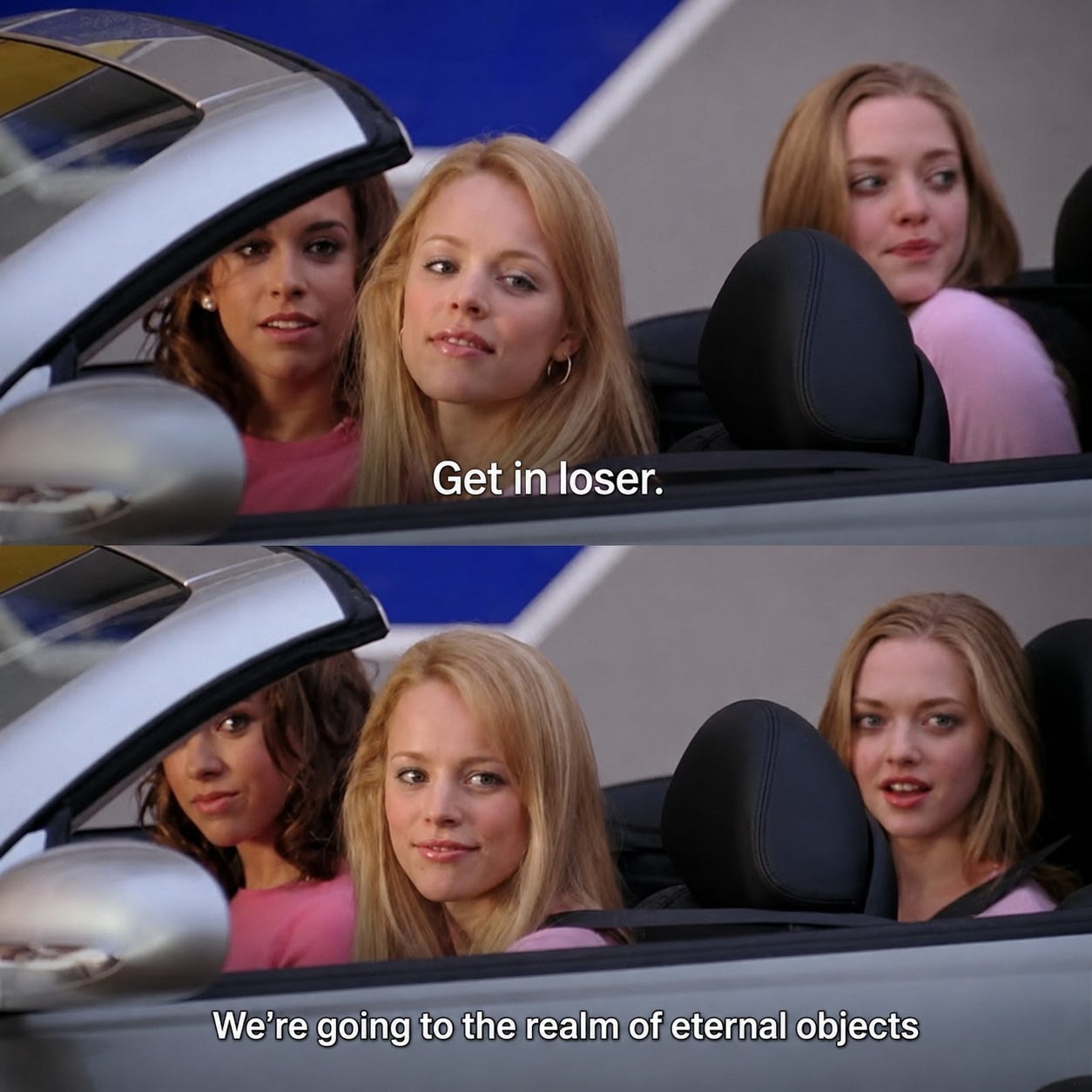
Is Whitehead’s so-called “realm of eternal objects” a predefined cosmic inventory, state space, or attractor landscape of exactly the kind Kauffman’s unprestatability forbids? And is Whitehead’s divine function a cosmic demiurge that coordinates the whole of possibility once and for all, such that the historic evolution of finite actual occasions is nothing but a paint-by-number operation rather than a real creative advance?
Revising My Propositional Proposal
Let me first restate my proposal in brief, so the revisions I want to make are clear as can be.
A proposition, for Whitehead, is not merely a linguistic statement, nor primarily a bearer of truth-value awaiting judgment, but a lure for feeling, a proposal about the way the world might matter, entertained by an occasion of experience within its concrete situation, and felt for its interest before it is ever affirmed. Whitehead says it is “merely credulous to accept verbal phrases as adequate statements of propositions. No verbal statement is the adequate expression of a proposition” (PR 13). The gap between verbal phrases and complete propositions is one reason he thinks the logician’s rigid alternative “true or false” is often irrelevant to the actual pursuit of knowledge, or indeed, of novel functions in the course of living. Logical treatment abstracts from the full experiential situation in which a proposition has meaning.
Propositions, then, are often more important for being interesting than for being true. But it is important that there be a fact of the matter by which their truth or falsehood could be determined.1 A proposition is hybrid in the sense that it indicates an actuality or constellation of actualities along with a predicative pattern that might characterize them. Like pure potentials or eternal objects, impure potentials or propositions are functionally indistinguishable from nonentity until and unless they are prehended or felt by a concrescing actuality. The locus of a proposition, then, consists of just those occasions of experience whose settled actual worlds already include the indicated actualities.
This locus condition is also a criterion of a proposition’s being entertainable. A proposition is available—feelable as a lure—only where its logical subjects are already settled actualities in some occasion’s achieved world. Lacking such subjects, there is no determinate reason upon which its truth or falsehood could be grounded, and what remains is not a proposition at all but a bare eternal object indicating nothing of its own ingressions (PR 256–57). A purely general description that refers only to properties and relations is, by this criterion, not a lure. The propositions that lure evolutionary advances are impure, meaning their possibilities are entangled with concrete, particular facts.
So then, let’s get more concrete. Consider feathers. Roughly 250 million years ago, before there were feathers, the free-floating proposition that “feathers are for flight” had no logical subjects at all, and so was not a proposition, nor a truth awaiting discovery, nor even a falsehood, but nothing that could be entertained or felt, since there was as yet nothing for it to be about. The arrival of feathers, which at first came to matter as insulation or sexual display, also does not suffice to compose it. Those first feathers gave the proposition candidate logical subjects, but prehending subjects were at that time still attending to prior functions. The aerial lure could be felt only later, within a lineage of occasions sheltered by bodies of a certain mass that had begun to run, leap, or glide.
Read as a bare statement, the sentence “feathers are for flight” names only universals—the naked possibilities of being-a-feather and taking-flight—and so, taken as a verbal statement, is not a proposition with locatable subjects. But “no verbal statement is the adequate expression of a proposition” (PR 13). Suppose we were an absurdly intelligent group of flying squirrel-like creatures (Volaticotherium antiquum, perhaps). Having already achieved modest forms of flight by means of membranes rather than feathers, we look on in amusement as the first dinos did their best to take feathered flight. Perhaps those features are for flying, one of us suggests to the other. Shortly thereafter, the same merely entertained proposition ingressed into actuality in an enterprising ancestor of Archaeopteryx. That “feathers might be for flying” went from being entertained as possible to defining a new functional adaptation.2
The adjacent possible is unprestatable, then, not because a determinate relevance is hidden from our finite minds, but because the relevant proposition has as yet no logical subjects. It cannot be said to be true or false, or even interesting, until it is compared to what is already actual. Novel propositions become available only when some existing trait, behavior, or morphology—perhaps originally surplus to, or underdetermined by, prior adaptive functions—comes to matter otherwise.
An eternal object tells no tales as to its ingressions. In abstraction, the pure potentials exhibited in a particular animal tail say nothing about whether they will be gathered into a rudder, a weapon, a fat storage organ, a fly swatter, a prehensile limb, or a balancing pole. The trait as a kind—the pattern exemplified by distinct lineages in the convergent evolution of prehensile tails in, e.g., monkeys, opossums, and seahorses—is a complex eternal object, a defining characteristic shared across distantly related lineages. What is not an eternal object is the concrete organ lineage that canalizes that characteristic into a specific enduring society of tail-occasions. It is a particular social lineage of tail-occasions, and not the universal kind, that a proposition takes as its logical subject. The tale that these tails are for balancing can be told only once one or more related mammals begin leaping between branches: it is then that new propositional lures can be felt, “tales that perhaps might be told about particular actualities” (PR 256). The proposition indicates these balancing tails, in their achieved field of relevance, as its logical subjects. It was not pre-existent in eternity, as if purchased from the frozen-food section of Trader Plato’s and defrosted into actuality. It is a tale that might be told about those tails only after bodies, habitats, and behavioral repertoires have composed the relevant locus. The tail’s new function is not chosen from a menu but felt as an adjacent lure within an achieved field of relevance.
In my initial proposal, I moved too fast in claiming that exaptation is “an old form in a new function” (PR 187). This phrase is actually Whitehead’s fallback qualification:
“A novelty has emerged into creation. The novelty may promote or destroy order; it may be good or bad. But it is new, a new type of individual, and not merely a new intensity of individual feeling. That member of the locus has introduced a new form into the actual world; or, at least, an old form in a new function.”
Form and function cannot be as easily prized apart as the simple formula “old form, new function” implies. A new Kantian whole (i.e., an organism whose parts are reciprocally ends and means) is not old parts given a new use but a new mode of organization or individuation in which the parts have become other than they were. Exaptation is the transformation of an existing trait or underdetermined effect through a new propositional lure within a reorganized locus of organism-environment relevance. It enrolls not only already functional organs but side effects (e.g., Kauffman’s heart sounds) and apparent epiphenomena, such that what was inconsequential becomes consequential. What begins as appearance later becomes actual—where “appearance” means not an illusion but a proposal, a might-be. A new contrast may matter aesthetically before it matters adaptively, hovering in a propositional penumbra until, decided upon by an actual occasion and stabilized within a society, the lure becomes a lineage, “[paving] the way along which the world advances into novelty.”
Releasing the Hostages
Defining eternal objects as uncreated forms of definiteness can make it sound as though one has posited a completed space of possible outputs, a pre-cosmic inventory of already decided forms, an a priori attractor landscape predetermining what can happen. Kauffman’s unprestatability forbids this. Juarrero affirms the evolutionary emergence of truly novel forms. Jackson refuses to worship an uncreated infinity of predefinites graded all at once. These are all commitments I take to heart and intend to share, even if by other means.
Why not just pay the ransom? Why not stop clutching at pure potentials, and just be happy with the abundance of the impure intermediaries like propositions, contrasts, and real potentials? They do most of the work, anyway! Why not scrub myself clean of archaic Platonic residues as so much metaphysical baggage weighing down the advance of a thoroughgoing evolutionary cosmology?
Because. I cannot shake the worry that paying the ransom would bankrupt the whole enterprise of metaphysics. No thinker thinks twice, as no world worlds twice. But I still agree with how I put it at the end of an earlier study of Whitehead’s eternal objects: (“Standing Firm in the Flux” in Whitehead at Harvard, 1925-1927 ed. by Joseph Petek and Brian Henning [Edinburgh University Press, 2026]):
We must return to the crucial question, whether we can think the unreality or superfluousness of eternal objects without falling into self-contradiction. Even posing the general post-Kantian problem as to whether metaphysics is really possible is already to be engaging in metaphysics. The very claim, “only actual entities are real” presupposes we know what it means for an entity to be unreal, i.e., merely possible, unactualized, or, indeed, impossible. It is precisely in order to explain such cognitive claims that Whitehead included the category of eternal objects as a speculative hypothesis. “The mind does not create such objects; they stand up against the mind, in their own right” (HL1 96). Whitehead is thus defending a qualified realism regarding universals as against the doctrine of nominalism, which has it that only particular entities are real with universals reduced to general names. His realism is “qualified” in that (i) he rejects the Platonic habit of granting preeminent reality to universals, and (ii) he accepts that the recognizable identity of enduring physical objects—e.g., Cleopatra’s Needle, which “daily [loses] some molecules and [gains] others”—is relative to the degree of abstraction of one’s definition. Eternal objects have no experience of themselves and no value independent of their function in concrescence (HL2 115). Exclusive reflection upon eternal objects within a stream of conscious occasions of experience leads to a rapid decrease in importance, as an idea becomes an idea of an idea, and so on, in a vicious spiral into abstract timeless irrelevance (HL2 105n9). It is the concrete particulars that have preeminent importance and that enhance relevance, and yet they cannot be what they are without also including what they are not. In other words, actualities necessarily refer to possibilities on their way to realizing their definite value. Rather than allowing finite actual occasions to evaporate into abstraction (as both Absolute Idealists [HL1 123] and inverters of Whitehead’s doctrine of possibility end up doing), Whitehead insists upon their concrete status as the locus of real value in the world. And yet, despite acknowledging various intermediate categories of existence, including real potentials, contrasts (or “relational tropes”), and propositions which lack the “purity” of eternal objects, and which various critics have pointed to as sufficient to play the role of said objects sans any Platonic baggage, Whitehead nonetheless maintained that metaphysics must account for our conceptual capacity to recognize entities that involve no necessary reference to any particular actual entities of the temporal world (PR 44). In the end, Whitehead admits the obscurity of the problem he is trying to address, specifically, the “transition from Platonic ideas to reality,” where on his own account his philosophical scheme traces only “a ghost of a glimmer of light” (HL1 98). The hypothesis of eternal objects does shed light on many a problem, even if it also leaves us with some “ragged-edges” (HL1 488).
Even for a descendental philosopher like me, who like most everyone else initially ran head first into Whitehead’s puzzling defense of eternal objects, the importance of permanence in a philosophy of flux eventually struck a nerve. I realized that, in trying to deny them, I could not state my own position coherently without borrowing precisely what I meant to abolish. To say “only actual entities are real” is already to claim to know what it would be for something to be unreal. The cognitive capacity for negation is, in part, what the category of eternal objects is introduced to explain. That pure potentials form an unavoidable pole in the magnet of metaphysical schematization is not an argument that they constitute a pre-determined phase space. I would only insist that the function they designate cannot be waved away, since any such waving already assumes it. At minimum, then, the capacity for negation shows that actuality alone does not exhaust intelligibility. Whether this surplus of possibility is a quirk of human cognition or the trace of a more general cosmic function is a profound metaphysical question. If, like me, you are not content with the anthropocentrism implied by hogging all the negativity for ourselves, it suggests the cognitive function of eternal objects is indeed sourced in a cosmic function.
Despite calling them a “realm,” Whitehead’s realism about their function is qualified in ways that I think keep it from metastasizing into a demiurge’s warehouse of spare parts. Whitehead inverts the Platonic habit of granting eternal objects preeminent reality. The mind does not create eternal objects but neither do they govern it. Their ineffectual indeterminate definiteness throws but a ghost of a glimmer of light upon what is meant by their pure potentiality, which is just enough to avoid the reification that would come from imagining a floodlit inventory.
I am unable to pay the ransom. I must instead negotiate a distinction between the function and the reification of eternal objects. Novel propositions, contrasts, and the societies that stabilize them genuinely become, even if “there are no novel eternal objects.” A new function for a proboscis or a protein that folds differently is an unprestatable historical achievement. What is exempted from novel exaptation is not the function—the what-it-is-for of an organ or behavior, which is historically achieved—but the form. The eternal objects are just the uncreated forms of definiteness, and it is not these forms that exaptation makes. This or that definite shape of a feather or a tail—abstract characteristics that could also show up in other lineages—is exemplified by concrete historical achievements but not produced by them.
The bare determinability of an eternal object does not have the sort of reality whose genesis or location we might ask after, any more than we would ask where the octave is stored, or on which morning three came to stand to two in that relation. Of course, no particular sounding of a fifth perfectly exemplifies an exact ratio, and of course the recognizable reproducibility of musical intervals depends upon extensive material, physiological, and cultural construction. The genesis of the conditions that make even their approximate sounding and hearing possible does not yet explain the definiteness of the ratio itself. That its definite determinability is “uncreated” is not some spooky ontological claim about its having existed since before the beginning of time but a transcendental claim about its modality, about how potentiality exists rather than which particular tasks it comes to serve.
An eternal object is not an antecedently completed model that an actuality might copy, nor an ideal token stored outside history. Its function is to account for the identity of definiteness across diverse, imperfect realizations. Eternal objects are implicated in the passage from Whitehead’s ultimate category, Creativity, to determinate creatures. Creativity is the advance into novelty, but it does not explain why what becomes acquires this character rather than another. Definite potentiality is therefore no rival to emergent functionality but one of its conditions of possibility. It allows a novel constraint to be tracked, whether by an observing scientist or by the living society whose characteristic form it helps organize, as a determinate recurrence rather than dissolving into unrepeatable change.
Both the scientist’s recognition of a form and the society of actual occasions’ inheritance of a defining characteristic require identity of definiteness across differences of realization. Recognition and reproduction are the epistemic and ontological faces of recurrence, and recurrence presupposes the “of,” the relation of ingression. This does not mean that some self-identical token migrates from occasion to occasion but that the same form of definiteness is realized in numerically distinct actualizations as the identity of a what, not of a this. Without such repeatable definiteness, an emergent constraint would be indistinguishable from unrepeatable flux, both to the scientist seeking to identify it and to the lineage struggling to persist by means of it.
Eternal objects, considered in abstraction from particular actualities, do carry some formal structure. Whitehead’s complex eternal objects, and the mathematical forms underwriting his theory of extensive connection, convey real order, patterns and patterns of patterns. What the eternal objects, considered as pure potentials, do not yet carry is a metric fixed in advance of the historic world, nor a pre-determination of relevance assigning which of them will come to matter to which occasions. Pure potentiality is not, in that sense, a dimensional or a metrical order, nor a completed state space or fully specified geometry. The realm of forms is as richly structured as is required for Whitehead’s mereotopological account of possible relations. What remains unprestatable is not objective possibility but relevant possibility, that is, the achievement of a function within a lineage of actual occasions. Kauffman’s adjacent possible is the continually recreated space of such functions, and functions are propositional, coming to be only with the occasions that feel them. The possibility of a coordinate, metrical space, likewise, arises only with the extensive continuum, which, as Whitehead clarifies, is “not a fact prior to the world” but a determination of real potentiality, atomized by the decisions of actual occasions and rendered measurable only within a cosmic epoch (PR 66). Coordinate state space is built and rebuilt by each actualization, from the bottom up. It does not descend from an eternal lawmaker as if fixed in advance. Whitehead says the extensive continuum:
“is Kant’s ‘form of intuition’; but it is derived from the actual world qua datum, and thus is not ‘pure’ in Kant’s sense. … It is not productive of the ordered world, but derivative from it” (PR 72).
Kant’s legislating understanding is the demiurgic designer shrunken (or perhaps egoically inflated) from cosmogony into the epigenesis of the human mind, the self-construction of an order imposed on the world a priori. Whitehead inverts the Kantian move, such that order is derived from the decisions of creatures, not imposed upon them.
As for the other hostage, God, whom Whitehead categorizes among the “derivative notions” of his scheme, I am happy to exorcise any demiurge who might coordinate the whole of possibility once and for all. If God were a completed valuation performed before the world, ranking the relevance of a fixed hierarchy of eternal objects and impassive to the value-experiences of finite actual occasions, I would not ask for the hostage’s release but for a harsher sentence.
But God is “not before all creation, but with all creation” (PR 343). To picture the primordial envisagement as a survey of everything that could occur completed in advance of the world’s creation is just the fallacy of misplaced concreteness. Creation is ongoing, God as much a creature of Creativity as we are. But denying the demiurge does not dissolve the relational function of the divine. I read the primordial nature as living always in the present as the initial aim each occasion feels as relevant to its situation, a gift of graded relevance amidst the otherwise indefinite infinitude of possibility. God is not a speculative abstraction but the most ordinary, constant, and so easily missed fact at the base of every experience. God is the soliciting Eros that makes our own subjective aim and superjective decision amidst alternatives possible (without determining our decisions). God does not create nor even define the forms, but values them, providing a standard of relevance for the unique here and now of each occasion. Definiteness is not yet relevance. The divine function is not the keeping of an inventory of possibles—reality needs no such warehouse—but the valuation by which some possibles come to matter here rather than there. The definiteness of the forms is uncreated, but their effective relevance for the world is a primordial but “deficiently actual” (because merely conceptually prehended) fact longing to be recreated afresh as relevance is renewed with every becoming.3 God’s eternality is not in stasis beyond time but is time’s fullness. God remains in continuous creation in and as every creature, with the primordial envisagement of possibility being enriched by each novel fact as it arises and perishes into God’s consequent nature.
None of this necessarily brings any negotiations to an end. Whether graded relevance is historical construction all the way down, the result of coarse-graining with no ultimate ground, or an uncreated condition of evolutionary construction, is a question that will no doubt continue to linger. But I cannot myself make sense of the former possibility. “Effective relevance requires agency of comparison” (PR 31). Without the divine function, possibilities that transcended realized temporal matter of fact would remain relatively nonexistent for a given finite occasion. Of course, all these functions and their internal relations are the free creation of a particular twentieth-century European-American philosopher’s rather idiosyncratic scheme of ideas. Novel mutations, such that old functions take on a new form, are always possible, as is the scheme’s extinction.
“[A] system of philosophy is never refuted; it is only abandoned. … after a system has acquired orthodoxy, and is taught with authority, it receives a sharper criticism. Its denials and its incoherences are found intolerable, and a reaction sets in.” (PR 6)
Still, we are in no danger of a Whiteheadian orthodoxy anytime soon. So I will press on in the spirit of his experimental adventure. Every categoreal scheme, the one I ply no less than anyone else’s, is finally a matter of faking it until we make it, always with ironic sincerity, since we will never quite make it.
“Rationalism is an adventure in the clarification of thought, progressive and never final. But it is an adventure in which even partial success has importance” (PR 9).
Spiral Revision
This is spiral genesis, revised. The spiral image is intended to signal actuality arising out of underdetermination, lured by propositions that, once recurrently decided upon, stabilize into a lineage, which itself becomes the datum for further propositions. No doubt the relevance of these ideas bleeds beyond biology. The graded envisagement by which any occasion feels its situation in contrast to alternatives is at once “the source of error, of truth, of art, of ethics, and of religion” (PR 189). A contrast entertained aesthetically before functioning adaptively is no trifling epiphenomenon but the way the merely possible first comes to matter. It is beauty revealing itself as a leading edge of the process of realization.
A living society lives by a kind of robbery, according to Whitehead; and the robber requires justification (PR 105). Gradations of purpose and responsibility enter the world together with the lure of intensive relevance, so that the biological and the ethical are not, in the end, entirely severable subjects. My propositional reading of exaptation is a refusal of the bifurcation of nature into objective fact and projected value. On this account, what begins as appearance later becomes actual. The first shy shimmering of relevant novel contrast, before truth, function, or inheritance, is how the world is called to become more than it was.
It is worth quoting Whitehead at length on this point:
“A proposition enters into experience as the entity forming the datum of a complex feeling derived from the integration of a physical feeling with a conceptual feeling. Now a conceptual feeling does not refer to the actual world, in the sense that the history of this actual world has any peculiar relevance to its datum. This datum is an eternal object; and an eternal object refers only to the purely general any among undetermined actual entities. In itself an eternal object evades any selection among actualities or epochs. You cannot know what is red by merely thinking of redness. You can only find red things by adventuring amid physical experiences in this actual world. This doctrine is the ultimate ground of empiricism; namely, that eternal objects tell no tales as to their ingressions.
But now a new kind of entity presents itself. Such entities are the tales that perhaps might be told about particular actualities. Such entities are neither actual entities, nor eternal objects, nor feelings. They are propositions. A proposition must be true or false. Herein a proposition differs from an eternal object; for no eternal object is ever true or false. This difference between propositions and eternal objects arises from the fact that truth and falsehood are always grounded upon a reason. But according to the ontological principle, a reason is always a reference to determinate actual entities. Now an eternal object, in itself, abstracts from all determinate actual entities, including even God. It is merely referent to any such entities, in the absolutely general sense of any. Then there can be no reason upon which to found the truth or falsehood of an eternal object. The very diversity of eternal objects has for its reason their diversity of functioning in this actual world.” (PR 256-257)
On its own, the proposition “feathers are for flight” imperfectly indicates those feathered forelimbs, in their achieved field of relevance, as its logical subjects. I must thank Ben Snyder (a frequent guest in my footnote acknowledgements!) for his helpful criticisms that motivated my clarifications on this point.
“…as primordial, so far is [God] from ‘eminent reality,’ that in this abstraction [God] is ‘deficiently actual’—and this in two ways. [God’s] feelings are only conceptual and so lack the fulness of actuality. Secondly, conceptual feelings, apart from complex integration with physical feelings, are devoid of consciousness in their subjective forms.
Thus, when we make a distinction of reason, and consider God in the abstraction of a primordial actuality, we must ascribe to [God] neither fulness of feeling, nor consciousness. [God] is the unconditioned actuality of conceptual feeling at the base of things; so that, by reason of this primordial actuality, there is an order in the relevance of eternal objects to the process of creation. [God’s] unity of conceptual operations is a free creative act, untrammelled by reference to any particular course of things. It is deflected neither by love, nor by hatred, for what in fact comes to pass. The particularities of the actual world presuppose it; while it merely presupposes the general metaphysical character of creative advance, of which it is the primordial exemplification. The primordial nature of God is the acquirement by creativity of a primordial character.” (PR 343-344)
Your continued exploration of this tricky topic has been indispensable in clarifying the crucial roles/functions of eternal objects and potentiality in Whitehead’s scheme, which has certainly refined my thinking. However, I remain unsatisfied with eternal objects and believe Whitehead’s scheme can survive largely intact by carefully reframing potentiality.
“Eternal objects, considered in abstraction from actualities, carry no coordinates, no metric, none of the pre-given structure that would make them a state space. Pure potentiality is not a dimension or a metrical order.”
As I understand it, your argument for the adequacy of eternal objects as a conception of pure potentiality (in spite of the commitments you affirm from Kauffman, Juarrero, and Jackson) rests heavily on your ability to insulate their definiteness from their position in some space, whether that be the extensive continuum, a Platonic realm of forms, or any other pre-given state-space. But as I argued in our recent exchange on Facebook, I think that effort falls flat within Whitehead’s scheme precisely because eternal objects are ordered by the primordial nature of God: “Such a primordial superject of creativity achieves, in its unity of satisfaction, the complete conceptual valuation of all eternal objects. This is the ultimate, basic adjustment of the togetherness of eternal objects on which creative order depends. It is the conceptual adjustment of all appetites in the form of aversions and adversions. It constitutes the meaning of relevance.” This positions eternal objects within a relevance landscape that licensed Whitehead to drop his category of conceptual reversion while still allowing concrescing occasions to conceptually prehend relevant eternal objects (e.g., the adjacent possible) and introduce novelty while maintaining coherence and intelligibility in the actual world process. It is true that this relevance landscape is not a metrical space (i.e., there is no meaningful distance function), but it is certainly a topological space that carries notions of adjacency and relational structure. And so the questions remain: Can the definiteness of eternal objects be disentangled from their relational position within this primordial valuation, which serves as a sort of pre-given state-space? What could we possibly mean by “definite” without the implicit notions of contrasts, boundaries, or properties provided by relational forms within some relational context, be it abstract or concrete?
“Whether graded relevance is historical construction all the way down, the result of coarse-graining with no ultimate ground, or an uncreated condition of evolutionary construction, is a question that will no doubt continue to linger. But I cannot myself make sense of the former possibility. “Effective relevance requires agency of comparison” (PR 31). Without God, possibilities that transcended realized temporal matter of fact would remain relatively nonexistent for a given finite occasion.”
I just finished expressing skepticism that one can insulate the definiteness of eternal objects from their position in a pre-defined state-space in Whitehead’s scheme. This is a direct consequence of Whitehead’s own answer to the question, “how, and in what sense, one unrealized eternal object can be more, or less, proximate to an eternal object in realized ingression” (PR 249), which was God’s primordial valuation/ordering of eternal objects. It seems to me that the perceived need for an agency of comparison arises precisely because eternal objects are first conceived as definite independently of their relational context. So, it seems your proposed justifications for releasing these two hostages may work against each other. The agency of God is invoked to explain how definite eternal objects could attain relevance to each other, but the achievement of that relevance landscape makes it difficult (if not impossible) to insulate their definiteness from their position within a pre-given state-space without treating definiteness as something that is intelligible independently of the very relational context that is supposed to render eternal objects relevant.
My paper-in-progress builds on these and related arguments to explore whether Whitehead's own relational insights can be extended into potentiality without appealing to eternal objects as pre-definite forms. I hope to have something worth sharing in the coming months.
Sorry to be providing so much criticism of your Whitehead readings lately (I guess I have to fit them all in before you head off to the Whitehead conference). I think this is a good example of where contemporary philosophy of language and analytic metaphysics can help clarify Whitehead’s theory and its relevance to contemporary philosophy of science.
What would it mean for propositions to be “logical sentences”? Propositions the abstract objects ambiguously expressed by declarative sentences; this much is very familiar in analytic philosophy. It is also not distinctive of Whitehead to have propositions be “lures for feeling”: the analytic way of saying that would be, that propositions are the possible content of propositional attitudes.
Propositions being “hybrid” entities, composed of particular and abstract entities, is what is called a Russellian structural theory. The further consequence of this, that singular propositions contingently exist when they have contingent particulars as parts, is what is often called (following Plantinga) “existentialism.” This existentialism is the relevant thesis you’re utilizing here, though I’m skeptical of how you are utilizing it.
The crucial point is that, by Whitehead's reasoning, propositions are only nonexistent in a world when referring to particular actual entities that don’t exist in that world. The upshot is that all purely general propositions thus still exist and are meaningful/statable, as are higher-order propositions only naming properties and relations (insofar as we interpret these to be referring to eternal objects). Thus, whatever can’t be named directly could still be described (i.e., you could say, there is some x such that x has traits P, Q, and R and x is …).
Thus the problem with your example: “That feathers might become flight-worthy requires a world in which there are feathered reptiles of a certain body mass, a particular atmospheric density, etc.” This is a world we are capable of describing in terms of properties and relations that are themselves universals. Your example, “feathers are for flight”, does not really seem to be a statement naming any particular individuals. It is naming properties, namely, properties of an organism’s body parts (being a feather) and its actions (flying). Here, of course, is where your interpretation of traits as societies comes in, arguing that this type of description does, in fact, involve naming particulars, but to be blunt I do not think this argument makes sense.
Societies are concrete particulars for Whitehead. They are types of nexuus, where the members of the nexus are instantiating a common eternal object, the “defining characteristic.” I’d think biologists would generally want to be able to distinguish between a trait in general and a particular organism’s instantiation of said trait. Insofar as they are doing so, this is precisely the distinction between an eternal object and a society. Since we can talk of the convergent evolution of traits, we can talk about particular organisms sharing traits independently of their causal connection: a clear sign we are discussing properties being instantiated over distinct space-time events, and not a particular instantiation of a property at a particular space-time event. Much the same thing seems to apply to the types of behavior we can in turn consider a trait functioning for: these are _types_ of behavior we are describing in general, not particular instantiations of them.
The upshot of all of this, I believe, is that this approach is not really consonant with the kind of platonic realism of universals that Whitehead has. Once one admits universals into one's ontology, all of these traits and behaviors become describable in abstraction from any particular instances. You do not make it clear that we are losing anything relevant in our statements for a scientific theory when we move from discussing particular societies to discussing, in general, types of societies described in terms of their forms.
Whitehead uses the term “definiteness” primarily to refer to an attribute of actual entities: it is “the illustration of select eternal objects” (PR 25). An eternal object is thus a form of definiteness in the sense of being a form that contributes to an actual entity’s definiteness. Thus, contrary to what I take your reading to be, the eternal objects are the forms and not the definiteness. To put it even more specifically, the eternal objects necessarily are the forms that they are, whereas they contribute contingently to the definiteness of actual entities.
There is “pre-given structure” for eternal objects, since Whitehead has a theory of complex eternal objects, i.e., an eternal object that itself consists of a pattern of other eternal objects and may be ingressed as one complex structure. This is also familiar to more contemporary metaphysics as a theory of “structural universals.” Whitehead has eternal objects that serve the role of “Platonic mathematical forms”, which are thus the basis for his theory of extension and provide the geometrical structure involved in complex eternal objects. These are the regions and the binary relation of connection elaborated in his mereotopology: other simple eternal objects, sensa, can then be located at regions and thereby form into complex ordered forms. That the extensive continuum is in part derivative from the actual world does not mean the geometrical forms of structure are themselves contingently created, but that the actual world contingently ingresses some structure rather than others (out of a given realm of possible forms of structure).
There are thus many aspects of this argument I’d want to see given some more detailed or made more convincing—and not just in terms of being an accurate reading of Whitehead. What is the criterion for a proposition’s statability? How do propositions about traits fall under the conditions of thus not being statable? In what sense are eternal objects capable of being structured, and in what ways is said structure only contingently derived from the actual world?