
Against Physicalism's Misplaced Concreteness
On Whitehead's Process-Relational Panexperientialism


Below, I respond to Deivon Drago’s attempted refutation of contemporary forms of panpsychism. I draw primarily on two published articles of mine that address much of Drago’s concerns:
“The Varieties of Physicalist Ontology: A Study in Whitehead’s Process-Relational Alternative,” The Journal of Philosophy, Theology, and the Sciences. Vol 7, Iss 1 (2020).
“Physics Within the Bounds of Feeling Alone,” in World Futures: The Journal of New Paradigm Research Vol. 80, Iss. 8 (2024).
The meat of my arguments are in those articles, but below I try to parse out a few responses to Drago’s post.
Drago begins by dismissing panpsychism as “a relic of prescientific animism.” I’ll raise the stakes by placing Alfred North Whitehead within a rich lineage of scientific animists, including Giordano Bruno, Gottfried Leibniz, and Gustav Fechner. They all refused the modern fantasy of dead matter awaiting the miraculous late arrival of mind. Contemporary analytic panpsychists tend to cite Bertrand Russell as their progenitor, oddly neglecting his friend and collaborator Whitehead, who developed what remains, to my mind, the most sophisticated panpsychist (or better, panexperientialist) metaphysical scheme available. I should say at the start that I grant most of Drago’s criticisms of the forms of panpsychism he chose to refute. All those forms assume a substance ontology. Whitehead’s panexperientialism assumes an alternative process-relational ontology that may be as different from the substance-property variants of panpsychism as it is from materialism.
Whitehead’s panexperiential view of the universe is not a result of ignoring physics. In fact, it was the early 20th century revolutions in physics that motivated Whitehead to develop his novel metaphysical scheme. He saw clearly that the old mechanistic materialism had become entirely untenable in light of the discoveries of relativity and quantum physics. Whitehead’s process-relational panexperientialism does not lead to the claim that electrons are conscious. Nor is it the claim that consciousness is an extra occult force added to the inventory of physical causes. It is a far subtler attempt to overcome the modern bifurcation of nature: the split between a supposedly objective world of merely extended, valueless matter and a merely subjective world of color, feeling, meaning, purpose, and value.
Whitehead’s question is not, “Where might we find consciousness hiding inside the already completed physicalist picture?” His question is: what must nature be like if feeling, valuing, scientifically informed conscious organisms like us are among its evolutionary achievements? A comprehensive cosmology must account not only for physical happenings, but also for human experience, since after all, all our physical models are derived from the purposive experimentation and mathematical reflection of conscious scientists. Our conscious thinking, feeling, and willing are not embarrassing anomalies to be explained away. Instead, they are high-grade exemplifications of experiential powers latent throughout the physical universe.
As William James long ago argued, if consciousness evolves, it cannot appear suddenly from absolute experiential zero. Nature makes no such ontological leaps. James already saw that consciousness could not be an inert spectator floating uselessly above organic life. Whitehead generalizes this insight cosmologically: experience does not intrude into nature from elsewhere but grows within nature, intensifying from the dimmest forms of physical feeling into the vivid immediacy of animal consciousness and eventually the self-reflective thought of human beings.
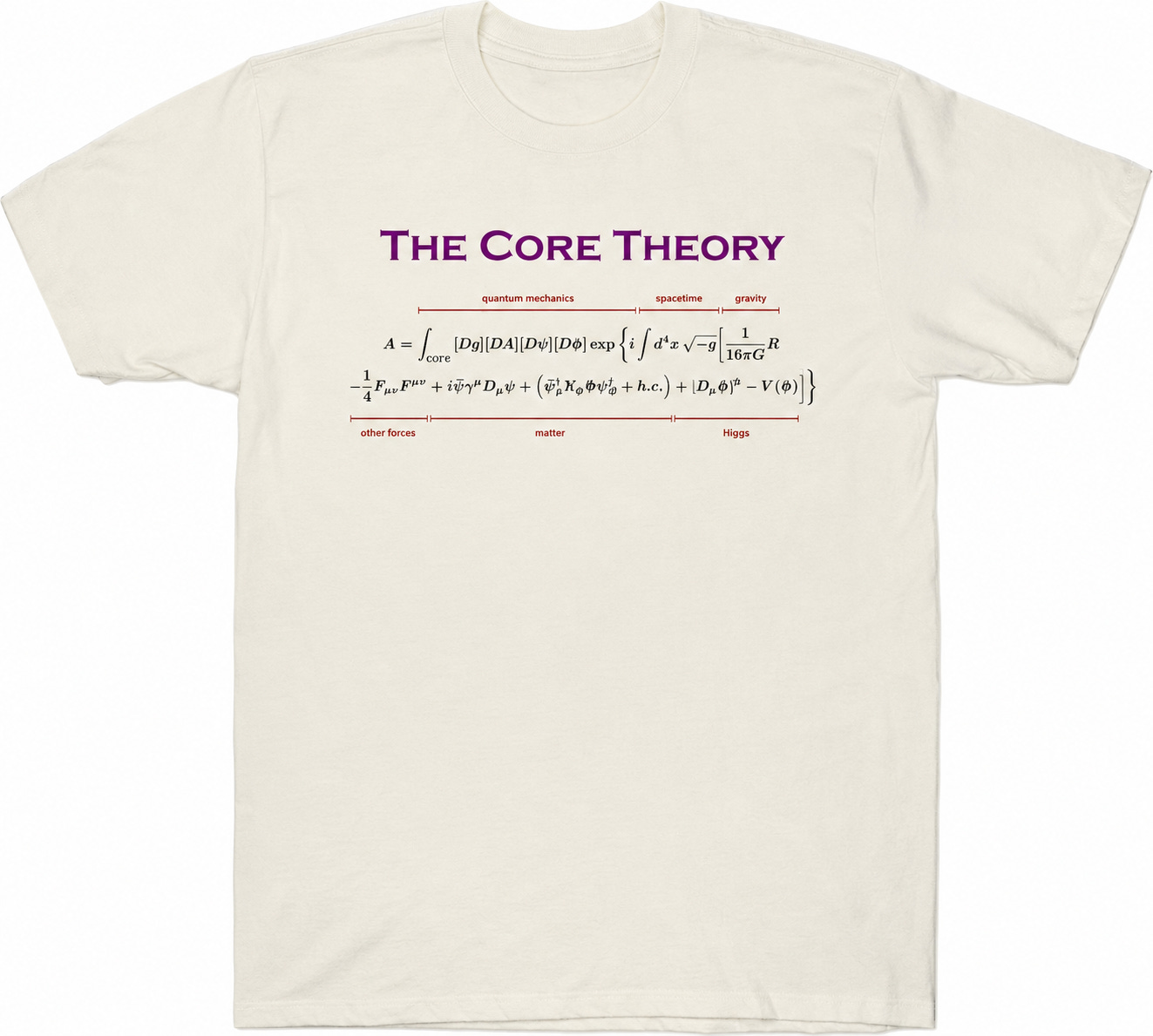
Drago makes use of physicist Sean Carroll’s objection to panpsychism. The objection says either consciousness modifies the so-called Core Theory (a mashup combining quantum mechanics, spacetime, gravity, matter, the Higgs field, and other forces), in which case we should detect it experimentally, or it does not, in which case it is epiphenomenal. But this dilemma only works if one has already assumed that the Core Theory gives us concrete nature in itself, rather than a partial, abstract, formal, predictively powerful set of successful models whose empirical touch points are themselves abstracted from experience. While the individual components of this Core Theory represent tremendous achievements of scientific reasoning, the mashup version is better suited for a Mindscape Podcast fanboy t-shirt and should not be mistaken for a serious physics equation. In practice no one has ever succeeded in combining the mashup into a working model or simulation (see my review of physicist and philosopher Tim Eastman’s book Untying the Gordian Knot for more on this point).
In his book The Big Picture (2013), Carroll leans on his scientific credentials to assure us that even our most prized “inner experiences” can only really be “a way of talking about what is happening in the brain.” If consciousness (i.e., all our thinking, feeling, and willing) is really just a way of talking about what is happening in the brain, then presumably all our scientific knowledge is also just a way of talking about what is happening in the brain? You see the problem.
The Standard Model of particle physics is an extraordinary achievement. But it is not the concrete real. It is not “physics” in the sense of nature herself laid bare. It is a set of mathematical abstractions and experimental protocols assembled from the activities of embodied knowers already immersed in a world of feeling. It does not precede experience. It is abstracted from and so depends upon experience. Mathematical symbolism, measurement instruments, and conceptual articulation allow scientists to carefully refine and coordinate what their propositions refer to. But without experience, there could be no propositions in play at all. Without experience, science falls silent.
So when panpsychists are asked to provide a new field, a new force, or a new term in the Lagrangian, the demand already assumes what needs to be put in question. Whiteheadian panexperientialism is not a rival physical theory. It is a metaphysical interpretation of what makes physical theory possible. It does not try to add consciousness to matter but shows that matter conceived as vacuous actuality devoid of all interiority, value, aim, or feeling, was never more than a useful abstraction. Methodologically indispensable, perhaps, but not metaphysically ultimate.
Physics gives us formal descriptions of the statistical patterns evident in energetic activity. Physicalists then turn around and pretend these abstractions can explain away the very experience from which they were abstracted. That’s not physics anymore, it’s (bad) metaphysics. A partial mapping is mistaken for the entire territory. Or better, a dashboard is mistaken for the engine. The equations of physics are not the blood and bones of the universe. They are beautiful and powerful abstractions from a more concrete field of experiential activity. Nature is not a bloodless dance of numbers, as Whitehead would say (subtweeting F. H. Bradley). Real facts are happening.
…
I do agree with Drago that Chalmers’ “hard problem of consciousness” is poorly conceived. It frames the problem in a way that obscures how far upstream the real source of the issue is. First, modern science methodologically excluded subjectivity, feeling, value, and purpose from its picture of nature in order to make possible mathematical prediction and control of the ideally isolated systems left after the strip search. Then, having forgotten the methodological character of this exclusion, science finds itself asking with great puzzlement how subjectivity, feeling, value, and purpose could ever have arisen in the universe.
The appeal to neuroscientific research programs like predictive processing and global workspace theory cannot resolve this issue. Of course we should study neural correlates of consciousness. Of course we should investigate attention, memory, visual processing, error correction, and the evolutionary advantages of integrated responsiveness. None of this threatens or is threatened by Whitehead’s critique of bifurcation or his alternative process-relational ontology. Indeed, Whitehead gives us a more adequate metaphysical background for these sciences, because he does not treat information, integration, valuation, or aim as ghostly intrusions into a universe otherwise composed of vacuous bits of matter.
One way to get to the beating heart of the issue is to ask what is meant by “information processing.” Neuroscientists routinely describe the brain as “goal relevant,” “selective,” and “sensitive.” But these terms already imply intentionality and purposefulness, even though the mechanistic biology upon which computational neuroscience often rests says such powers are impossible. Contrary to functionalist dreams of substrate neutrality, information is not a magic ether hovering above neurochemistry and steering it around. A difference becomes information only when it makes a difference for some actual perspective, some living or proto-living center of experiential concern. Whitehead’s term for this more primitive relational uptake is “prehension.” Prehension is not conscious reflection. It is not yet cognitive apprehension in the human sense. It is the basic way the past becomes ingredient in the present, as a transfer of feelings akin to an energy vector.

…
Drago’s analogy with vitalism also needs to be retired, or at least handled with far more historical care. One of the problems with the “urea moment” analogy is that, well, it’s a myth! Vitalism never suffered such an easy defeat. Historian of science Peter J. Ramberg has shown that the standard story of Wöhler’s synthesis of urea is just as mythical as Neil deGrasse Tyson’s retelling of Bruno’s martyrdom as part of the origin myth of modern science.1 In fact, Wöhler did not destroy or even seriously weaken belief in a vital force. Wöhler’s synthesis could be, and was, rejected as artificial because his starting materials might still have carried some residue of life. Well before Wöhler, his teacher the great vitalist chemist Jöns Jacob Berzelius, already assumed organic and inorganic chemistry followed the same laws of combination. And “vitalism” was never a single doctrine, anyway, but a family of positions concerned with the nature of living organization that persisted well after 1828. Read Ramberg’s chapter for the full story.
So as Drago intends it, the “urea myth” is an exceptionally poor analogy for what is going on in consciousness studies. On the other hand, once we see how and why this myth gained force, it does reveal some interesting parallels with the confusion around the panpsychism debates in contemporary philosophy of mind. Vitalism faded, mutated, and continues to reappear because the question it tries to address (what distinguishes living organization from mere aggregation) remains very much alive in theoretical biology. A competent historical treatment of this terrain can be found in Bohang Chen’s recent On the Riddle of Life: A Historico-Logical Study of Vitalism (2014). Chen shows how varied the vitalist traditions were, and why the problems they sought to resolve remain with us. Panpsychism, too, comes in a variety of forms, and has proved similarly enduring because of intractable problems in the study of consciousness.
If anything, the history of vitalism teaches the opposite lesson from the one physicalists often draw. Durable philosophical positions should not be dismissed too confidently as pre-scientific superstition. Their endurance indicates an unresolved conceptual incoherence in the reigning metaphysics. The hard problem may indeed be poorly formed, or at least biased toward Chalmers’ own property dualist proposal. But it highlights a real dilemma concerning the relation between third-person functional or causal description and first-person experience. Complicated brain mechanisms may help explain certain behaviors, visual processing, self-modeling, and various other isolated functions. But explaining why mechanisms that theoretically work perfectly well on their own are also associated with emotion, will, thought, and the disciplined logical reflection of scientists themselves is another matter entirely. Consciousness has had nothing like the mythical “urea moment,” and it is hard to imagine what that would even look like.
…
The combination problem is more serious. Constitutive panpsychism is often criticized for being unable to explain how the experiences of fundamental physical entities such as quarks and photons combine to yield the familiar sort of human consciousness we know and love. I think this objection has force against substance-property variants of panpsychism. If we begin with little bits of matter, each carrying its own little intrinsic mental property, then it is genuinely mysterious how these bits sum into a single subject. Of course, quarks and photons are not little bits of stuff but something more like vibratory excitations in a field. Even the latter image is but a metaphor trying to get at what the equations mean.
Whitehead does not begin with simply located bits of matter. He begins with events, occasions, processes, or acts of becoming. Many contemporary philosophers of mind still work with an outdated pre-quantum understanding of matter, something like Descartes’ res extensa. But we know the fundamental “particles” studied by physicists are not little lumps of stuff fully present at an instant. They are vibratory patterns of activity so intimately entangled that, as Whitehead put it, “any local agitation shakes the whole universe.” Every atom is fused into its environment. There is no detached, self-contained local existence.
Rather than struggling to understand how abstract little bits of extended matter with mental intrinsic properties might combine to form bigger bits of minded matter, Whitehead begins with a more concrete conception of energetic activity that is more easily analogized to agitations of experience. Neither matter nor mind is composed of simply located bits or isolated states. Both energy and experience are activities with fuzzy boundaries. Experiences, like energy vectors, are intrinsically process-relational: they manifest in a specious present as a tension between the actualized facts of an inherited past and the potential forms of an anticipated future.
Whitehead’s answer to the combination problem is “concrescence.” Here’s a crash course [should be timestamped to start about 1 minute in]:
Concrescence is not aggregation. It is the production of novel togetherness. It is the growing together of many prehensions or feelings of perished facts of experience into a new subjective actuality in the present, which itself perishes in turn to become a new objective fact available for future concrescences. The many become one, and are increased by one. The creation of each new actuality is a social effort employing the whole universe. And yet each new occasion of experience is also self-creating, an individual recapitulation of the universe, contributing its novel perspective back to the buzzing democracy of fellow creatures. Whitehead’s way of dissolving the combination problem was already nascent in William James’ original statement of it in Principles of Psychology. Whitehead’s account of the process of concrescence, whereby the many become one and are increased by one, directly builds on James’ suggestive phrasing of a “101st feeling,” a “totally new fact,” that brings together the
100 original feelings that signal its creation (James 1890, 160). Whitehead’s reframing of the metaphysical arena allows us to move beyond the false problem of having to combine spatially isolated substances to instead analyze the concrescence of temporally resonant events.
Cosmopsychism faces the inverse problem: the decombination problem. If the universe as a whole is one mega-subject, how do finite centers of experience split off from it? How does the cosmic mind become my mind, your mind, the mind of a bat, the dim sentience of a cell? Again, as you may have guessed, Whitehead reframes the issue. The ongoing composition of the cosmos is achieved neither through the summation of tiny parts nor through subtraction from some larger whole. It is achieved by a dipolar relational process with both a stability-providing physical pole and a novelty-inducing mental pole.
Whitehead is neither a micropsychist nor a cosmopsychist exclusively. He tries to have it both ways. There is a universal soul, a psyche of the cosmos, a primordial actuality or God of this world; and there are countless creatures creating in concert with it. The creativity of cosmogenesis transcends both God and finite actualities. It is the source of all co-evolving parts, wholes, bodies, and souls. Whitehead’s account of process includes moments of combination and decombination, conjunction and disjunction. The combination and decombination problems are transformed into the logic of concrescence, becoming features and not bugs: a way of thinking change as more than the rearrangement of pre-existing parts or the fragmentation of a pre-existing whole, but as genuine becoming, emergent evolution, creative advance.
…
Concrescence also answers the charge of epiphenomenalism. In Whitehead’s view, feeling is not a powerless glow emitted by neural machinery. Feeling is the very tissue of causal inheritance. The actual world is bound together in a nexus of physical feelings. Physical causation is already a primitive form of feeling: the reception of the past into the present. Mentality, in its higher-grade forms, is not a violation of physics but a diversion and intensification of energetic flow, an opening of possibility within inherited constraints, a shift in probabilities across scales of organization rather than a wrench thrown in supposedly deterministic physical gears. Consciousness does not hover above causal processes. It is a late, complex, evolutionarily intensified form of causal process becoming inwardly luminous to itself.
As for Dennett-style illusionism: the appeal to illusion does not eliminate experience. It presupposes it. If consciousness is an illusion, there is still something it is like to undergo the illusion. Calling experience a narrative construction, controlled hallucination, or self-model does not explain why there is any felt immediacy to delude us. A model that is experienced as a world is already more than a model in the merely formal sense. It is a lived world. The question is not whether introspection is fallible. Obviously it is. The question is whether fallibility about the contents of experience licenses denial of experience as such. It does not.
I’ve had a long conversation with the illustionist Keith Frankish. It revealed that illusionism and panexperientialism are closer than they may at first appear, at least to the extent that we both reject the poorly formed concept of “qualia.”

The tl;dr is that “qualia” renders experience in terms of substance-property ontology, where quales are the “intrinsic properties” championed by Russellian panpsychists. Whitehead’s process-relational account of experience frees it from the prison house of substance ontology. Experience is a relational process, not an intrinsic property sequestered inside material substances.
I agree that the hard problem is often framed badly. I agree that we should resist mysterianism. I agree that neuroscience has a ton to teach us. But the physicalist’s treatment of the status of consciousness usually depends on an equivocation. It describes the neural and functional correlates of phenomenology and then quickly declares that nothing remains to be explained. But correlation, functional mapping, and mechanistic description do not by themselves tell us anything about consciousness. In fact, they presuppose it.
Whitehead’s alternative is not anti-scientific. It is a protest against bad metaphysics masquerading as science. It asks us to bring natural science to its senses by refusing to split the world in two. We cannot describe a universe of blind particles and then, as an afterthought, say “oh, by the way, there is experience.” Nor can we describe a universe made of mathematical equations and then pretend that the physicists who value truth, beauty, evidence, and explanation are somehow external to the picture. A coherent cosmology needs to account not only for the laws of physics but for the physicists capable of knowing them.
The real issue is not whether consciousness is something additional to the laws of physics. That framing already grants physicalism its fallacious misplaced concreteness. The issue is whether the laws of physics were ever merely physical in the sense required by reductive materialism. Whitehead’s answer is no. Nature is full-blooded. Real facts are happening. Feelings are among the facts. Indeed, feeling is the only medium through which facts can come to matter.
In a popular origin story repeated by scientific materialists like Tyson, Bruno is described as something of a scientific martyr, burnt at the stake by the Catholic Inquisition for his heliocentrism. But it wasn’t his scientific views that led to his execution. The Renaissance scholar Frances Yates speculates that there was some political intrigue going on that upset the Vatican. The inquisitors were also way more upset about Bruno’s heretical theological views than about his Copernicanism (Copernicus’ astronomical research, by the way, was originally commissioned by the Vatican to help them improve the accuracy of their liturgical calendar). So it’s a much more complicated picture than the myth retold by Neil deGrasse Tyson in the revamp of the “Cosmos” TV series. I don’t think Tyson would want to defend Bruno’s panpsychism or practice of the magical arts!
I have read both Deivon Drago’s critique of panpsychism and Matthew Segall’s response carefully. As I reflect on these, I reflect that I am primarily engaged with a panpsychist perspective, not because it is conceptually watertight, but because it provides guidance as to how we humans should live convivially, respectfully, and creatively on this planet. From this starting point, both contributions miss what seems to me the most important point, which is not to get the theory right but to consider the essential issue of living well as humans as part of the community of life on Earth – which we are doing remarkably badly at present.
My own engagement has certainly not been a-theoretical, it is guided in particular by the ‘living cosmos panpsychism’ articulated by Freya Mathews. However, with my colleagues I have taken this further into critical experiential exploration through the Living Waters inquiry programme. For to adopt and practice some form of what Drago calls ‘cosmopsychism’ is not just to illuminate the origin of consciousness. It is to open a vision of the possibility that humans, alongside all living beings, have evolved as part of the creative process of the cosmos. We can think of ourselves as creative disturbances, eddies in an ever emerging, deeply woven whole, little selves that are part of the primary Self that is the cosmos. This allows us to see the cosmos is not simply alive, but by its nature communicative, seeking to engage with us in some poetic form – Freya Mathews terms this ‘ontopoetics’. It opens us to the possibility that as I sit in communion with River, when Kingfisher flies by, when Swans unexpectedly circle overhead, when a shower of rain falls on an otherwise dry day, these are responses to my respectful presence and invocation.
This practice of sitting communion with River suggests that we can find creative ways to check or corroborate our metaphysical position against experience. It provides an opportunity for thorough-going experiential inquiry in questions of the kind: What is it like to live in a world of sentient beings rather than inert objects? How do we relate to such a world? And if we invoke such a world of sentient presence, calling to other-than-human beings as persons, might we elicit a response? These challenging questions have been at the heart of a series of co-operative inquiries over the past six years, exploring our relationship with Rivers as sentient beings, involving over 120 human persons and at least as many bodies of water.
It has become evident to those involved in the inquiries that to live in a cosmos which is infused with interiority, a living, responding, meaningful cosmos, is quite different from living one experienced as brute matter. Through these inquiry practices our experience of the nature of our world is radically re-arranged. It becomes evident that experiences of a sentient, responsive, communicative world are available not just to Indigenous people living in traditional cultures, but to all human persons willing to put in the time, the attention, to risk their taken-for-granted sense of self, and to open themselves to that possibility. For some documentation of this process Learning How Land Speaks.
‘Take care of Country and Country will take care of you’ as Indigenous Australians have it, takes us to an utterly different world from ‘Drill, baby, drill!’ To live in a cosmos that we take as ‘deep-souled, subtly mysterious… of great spiritual beauty and creative intelligence’ (as Richard Tarnas puts it so beautifully in Cosmos and Psyche) puts us in a position from which it is no longer possible to create the kind of ecological havoc evidenced by advanced ever-more-extractive capitalist culture.
Of course, the philosophical arguments are interesting and important; we must be careful not to fool ourselves, and we need a rigorous intellectual frame as a starting point our inquiries or we will be in danger of drifting around in a sea of uncritical subjectivity. But we can cycle around questions of combination or decombination, we can articulate Whitehead’s elaborate scheme, without touching the imaginative possibilities of a panpsychic perspective as a new story to live by. Maybe the best use of theory, as Richard Rorty has it, is not to reach for truth but the redescribe our world in liberating ways. More than this, theories are double edged: they may illuminate but may also replicate the abstraction that has haunted western civilisation since very early times. Theorizing without resort to experience necessarily places us in the position of spectator, looking at a world that is essentially separate from us, ‘out there’ and so manipulable, which leads to the meta-crisis of the present time.
We may spend so much time getting our theory ‘right’, adjusting and disputing the finer points, that we forget that life is about living and so distance ourselves from the essential issue of living well on the Earth. We humans – we modern Western humans – need urgently to shift our sense of who we are, to experience ourselves, not through primarily intellectual endeavour, but directly, through our feelings, intuitions and imagination, as part of the whole. If panpsychism can play some part in facilitating this, it is worthy of our consideration and experiential exploration.
Tongue in cheek: Japan’s attempt to tame erosion by lining so many riverbanks with concrete has created its own ecological wounds. It is almost the mirror image of Whitehead’s fallacy of misplaced concreteness: instead of mistaking abstractions for reality, it mistakes concrete for wisdom — what we might call the fallacy of misplaced concrete.