
The Word in Every Tongue
From Crusade to Conversation in the Movement of Christianity Beyond Itself


I sat down with
for another conversation as part of his Christianity Beyond Itself series. Our first conversation was over a year ago: you can listen to it at this link.This series, in his words, is an attempt to name the conversation that is trying to happen around the return, transformation, and transfiguration of Christian forms in our time. Our first dialogue had been a keystone for him; this one felt like an attempt to revisit that inquiry in a moment when the tectonic plates of meaning seem to be colliding with even greater force.
What follows is a philosophical and spiritual attempt to recount that conversation and to deepen some of the themes that surfaced: the Christ-impulse and institutional containment, pluralism and plant medicine, the meaning of death and reincarnation, the wager of faith in a participatory cosmos, the musical nature of reality, the fraught relation between Islam and the West, the crisis of gender and “givenness,” and the difficult balance between church and initiation in a psychedelic age.
Christ beyond Christianity: magma and crust
I opened by naming what feels like a tremendous cultural earthquake under our feet. The civilizational tectonic plates that undergird our sense of reality—religious, political, economic, technological—are grinding against one another. Something new is emerging as hot magma, while there is also some crust that’s still heavy and fearful of the creative destruction that that magma will surely bring.
Christianity is one of those massive crustal formations. It is an ancient tradition with multiple institutions—some closer to the sources of the gospel than others—but the originating movement around Jesus of Nazareth is, at its core, utterly wild.
“The wind blows where it wills, and you can hear the sound it makes, but you do not know where it comes from or where it goes; so it is with everyone who is born of the Spirit” (John 3:8).
It cannot be fully contained in any institution, even though it absolutely requires communal crucibles. What I increasingly see is that our familiar institutional containers—church and state, and especially the “capitalist evangelical resonance machine” that fuses church and market (to borrow William Connolly’s phrase)—are all attempts to restrain the threat of the Christ impulse. They are buckling even as they try, in their panic, to tighten their grip.
To enter into conversation about Christ in such a moment feels like trying to grab a live wire. The intensity of the current can shock, polarize, or burn us. But it can also illuminate and energize.
Jacob sees different revivals happening: in his own life, in the liminal web, and more broadly in the culture. On one side, there is a Christic philosophical orientation that senses something genuinely new quite beyond what has been before that wants to be mediated and unfolded, a Christ beyond Christianity. On the other side, there is a strong impulse to “take up the sword of the Crusader”—to grab the core symbolic power of Christendom as a way to re-root, stabilize, and fortify a civilization that feels on the edge of massive change and decline.
In other words, there is Christ as universal mystery, and Christ as banner for a rear-guard civilizational project. The former calls us beyond our inherited forms; the latter clings to them in fear.
Pluralism, plant medicine, and the universality of the Word
Jacob described his own recent path: intensive participation in Catholic life—specifically Spanish Mass in Oaxaca—following a powerful ayahuasca dieta in Peru in which Christ-related visions played a major role. That period anchored him in prayer as a central practice and in God as the center of the whole puzzle. But after months of going to Mass several times a week and learning the prayers and songs in Spanish, he felt himself drawing back a bit from that patterning.
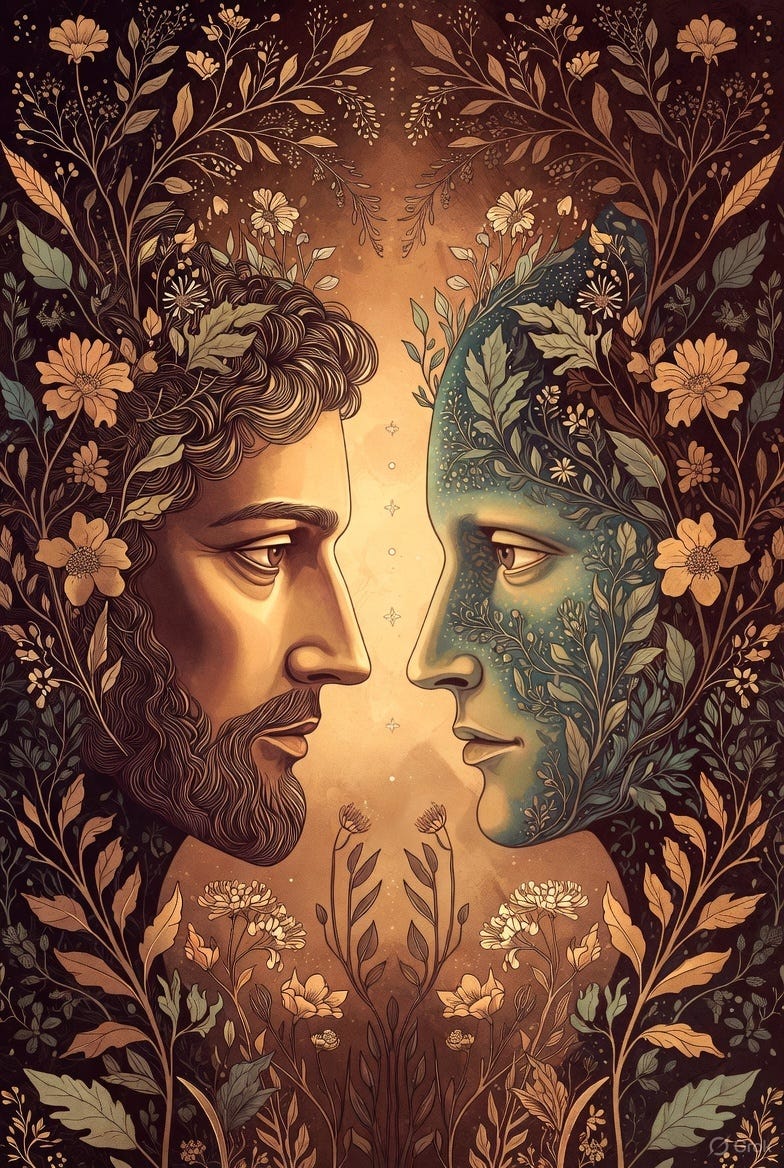
He recently attended a transpersonal psychology conference in Oaxaca where Christianity was hardly mentioned. Instead, he encountered a profound syncretic weave of transpersonal psychology, pre-Hispanic Mexican ritual, dance, temazcal sweat lodge, and a peyote ceremony led by a grandmother from the Wixárika (Huichol) tradition. In that context, he said:
“these indigenous traditions…have a completely authentic and profound grammar for connecting with the divine. They have a channel to God, and I have zero doubt about that because of the blistering, eviscerating beauty that I’ve encountered in those ceremonies.”
This brought him again to the question: how can Christianity be mediated in relation to these indigenous plant medicines, given the legacy of colonialism and la conquista that came with the cross and the sword?
For me, this is where Christian pluralism is not a luxury but a condition of fidelity to Christ. I suggested that the type of pluralism Jacob embodies is crucial if Christianity is to have a future. In the life and ministry of Jesus, what is most striking is that, despite the tremendous power unleashed by his deeds, there was a conspicuous lack of violence and coercion. It is a power of persuasion, of love, that crosses all cultural, gender, and racial boundaries to embrace all human beings.
Yet the religion formed around his deeds started to mistake the finger for the moon, defending inherited cultural forms rather than the living teachings and spirit that first gave rise to them. When that happens, other peoples’ ways of contacting the divine become threats rather than invitations.
If, however, we really affirm the oneness of God—and, in Christian terms, a triune oneness that is itself a mode of relationship—then what else could other peoples be worshipping and communing with, if not that same divine reality? We need semantic flexibility, the capacity to fluidly articulate, re-articulate, and malleably institutionalize something that, in the end, cannot be captured by any language or closed structure.
Here a Hegelian distinction helps: abstract vs. concrete universality. Abstract universality stands over against particularity, tends to erase it, and so becomes violent. Concrete universality includes plurality. It does not transcend difference by fleeing from it, but by recognizing that multiplicity is woven together by Spirit, and that Spirit speaks in every tongue. Pentecost becomes, then, not a magic trick, but a symbol of the Word’s capacity to address each people in their own language.
That is why Jacob suggested that if Christ is really true, you should be able to encounter him in an ayahuasca ceremony in the Amazon, in a peyote pilgrimage in the desert, in India’s temples, or wherever “spiritual otherness” confronts us. A truly universal Christ is not threatened by plural grammars of the divine. A merely universalizing Christ, by contrast, begins from “I’ve got it” and must therefore export it everywhere.
The paradox I try to inhabit is this: I feel at home in relationship with Christ and simultaneously as a committed spiritual and religious pluralist. I do not feel called to convert anyone. In fact, I enjoy being converted by others—by their traditions, images, and rituals—in ways that only deepen my sense of the love of Christ. In the rainforest, amid serpents and jaguars, in visions of Quetzalcoatl and other indigenous deities, I see among the infinite faces of the divine masks of the same mystery in whose face Christians name Christ.
Death, reincarnation, and the participatory wager of faith
We then turned toward death, and here the fault lines in modern secular consciousness became especially clear.
Jacob recounted a conversation after Día de los Muertos with family and a Mexican friend. When the topic of death arose, the friend imagined it as “everything going black forever.” Jacob remembered that this had once been his own default image of death—what he called the “baseline atheist reality”—and noted how profoundly that image shapes how we live, the space we hold for one another, and the choices we make.
For him, relationship with death—ergo, relationship with God, relationship with divinity—is the foundation of mental health. Any notion of mental health that abstracts from this existential ground is, at best, a band-aid.
I agreed, and tried to spell out both the phenomenological and ethical stakes. Imagining death as pure extinction—consciousness blown out, nothing remaining—is a suffocating picture. In a secular materialist culture, it becomes the unexamined default. We do not fully appreciate the extent to which this default takes the air out of our capacity to live meaningfully together.
Even if one appears mentally balanced while believing that death is simply the end, I suspect there are deep unconscious consequences. If, in the final analysis, nothing endures and it will be as if you never existed, what truly motivates you? Pleasure, comfort, convenience, perhaps some aestheticized sense of “tragic beauty”—but long-term responsibility? Care for future generations? The ethical consequences of a pure extinction view incline toward nihilism and short-term selfishness. Why not consume, accumulate, and enjoy as much as possible now, if there is no real sense in which your life participates in a larger story?
At the same time, I do not want to swing to the opposite extreme, where this earthly life is devalued in favor of a disembodied heaven. The question is not simply, “What happens after death?” but “What is the right way to live and die as embodied beings whose lives may be embedded in a larger spiritual process?”
Here I suggested reincarnation as an ancient and, I think, fruitful hypothesis. Reincarnation has a long pedigree: in Pythagorean and Platonic philosophy, in certain strands of Judaism (later developed explicitly in Kabbalah as gilgul), and in the early Christian theologian Origen’s speculations about the pre-existence and eventual restoration (apokatastasis) of all souls. We should note that classical, conciliar Christianity later rejected explicit doctrines of reincarnation; it is not a part of official Catholic, Orthodox, or mainstream Protestant teaching, of course. But as a way of imagining how finite lives contribute to a larger spiritual story, it remains compelling.
On this view, death is tragic because embodied relations are unique and irreplaceable; something is genuinely lost. Yet death is also a transformation: the soul gives back what it has learned to a larger spiritual reality—what I called the soul or spirit of humanity. Each life becomes one day in the life of a greater Anthropos, and our task is to learn something on behalf of that larger being.
I then brought in
’s re-reading of Pascal’s Wager. The old wager assumed a God who exists with a fixed nature, regardless of human participation, such that faith is a bet placed on an already settled metaphysical fact. McGilchrist instead suggests that if the divine is participatory—if God is, in Whitehead’s sense, an ongoing relationship between the world and an inexhaustible depth of value—then how we comport ourselves toward this mystery actually shapes its manifestation. Our fidelity or lack there of, our love or indifference, intensify or diminish the divine life in the world.In that light, faith is not just cognitive assent, it is world-making. Our love, our sense of participating in that divine life, intensifies the divine life. To the extent that culture recedes from that, the divine presence becomes dimmer in public experience. We bear a responsibility here: not merely to align with a pre-existing God, but to participate in God’s becoming.
On this participatory view, I find myself resonating with Origen’s hope that the salvific deed of Christ is, in some sense, already accomplished. We have all been saved, and yet it may take multiple lifetimes to fully accept and embody that salvation. You do not need to be a Christian for the deed to be real; we all already exist in communion with that field of love. My task is not to convert others, but to live in a way that helps this field become more tangible for them and for myself.
Hell, paradise, and the musical ontology of reality
From here we touched on the question, “How far can this world go in either direction?” If humans withdraw more and more from the divine, how devoid of sacred presence can the physical plane become? Jacob noted how hell is not just a mythic elsewhere; it is something humans can create on Earth. Conversely, paradise is not a static place, but a vector or direction in which reality can be moved, individually and collectively.
This raised a more hopeful question for him: “How much better can my experience become? How much more continuity of participation in the reverberation of the divine song could I experience?” The metaphor of resonance led him into the work of Hazrat Inayat Khan, the Sufi musician-philosopher whose The Mysticism of Sound and Music describes life as fundamentally musical.
I suggested that this musicality is not just a metaphor but an ontology. Creation is musical: order arises through resonance, through sustained patterns of vibratory relation. But any enduring order can become stale; improvisation is then required to complexify the song. We are always already in a choir of voices—human and more-than-human—and the task is to achieve ever more complex harmonies out of that choir of different voices.
Jacob proposed that a great deal of personal and ancestral trauma could be re-understood as being out of tune with the music of being, disconnected from our own indigenous sense of musicality, the sense of being attuned to a cosmic song. Trauma is dissonance that has lost its path to resolution. Healing, then, is not simply symptom management but re-tuning the vessel of the self so that we can receive and respond to the divine music again.
If we are tuned to the divine song, Jacob suggested, then you will pretty assuredly be able to hear it when it’s coming through, no matter where it’s coming from. That remark loops back to pluralism: a well-tuned instrument can hear the same melody in wildly different musical idioms.
Islam, Christianity, and the West: mirrors and fissures
From this musical vision we pivoted to a far more fraught theme: the relationship between Islam and the modern West. This is, for both of us, a central fissure that generates a great deal of incoherence and inner conflict.
I pointed to the way Islam currently functions as a kind of civilizational mirror for the West. Historically, especially during the Crusades and the Ottoman expansion, Christian Europe came to understand itself as the West in opposition to Islam. The “other” here was not a distant, incomprehensible barbarian. It was close enough in its monotheism, scripturalism, and prophetic lineage to serve as a mirror, but different enough to resist assimilation. As Nicholas of Cusa recognized in his 15th-century dialogue De Pace Fidei (“On the Peace of Faith”), Christianity, Judaism, and Islam share a deep metaphysical core and a Platonic heritage, even as they differ in law, ritual, and doctrine.
Modernity adds new layers. Eric Voegelin’s notion of “compact cosmology” is helpful here. In many Islamic societies, religion, politics, and economics remain more tightly integrated than in the West. Islamic law (sharī‘a)—understood in its broad sense as a way of life oriented toward God—links worship, family law, commerce, and social justice. The Five Pillars (profession of faith, the five daily prayers, fasting in Ramadan, almsgiving, and pilgrimage to Mecca) structure the day and the life-cycle. Zakat (obligatory almsgiving) and the prohibition of usury (riba) embody a concern for the poor and a suspicion of purely speculative finance. There is real room for markets and private property in classical Islamic law, so it is not “communist” in the technical sense, but its vision of wealth is subordinated to communal responsibility before God rather than to profit maximization alone.
By contrast, in the modern West religion, politics, and economics first differentiated and then, in many respects, dissociated. Capitalism was emancipated from theological and moral constraints; nation-states became secular power structures; churches were privatized and commodified. After this dissociation, all sorts of unholy alliances sprang up—evangelicalism fused with neoliberal capitalism in the United States, for example—where money became the main practical bridge between otherwise hostile religious blocs. I mentioned Crown Prince Mohammed bin Salman visiting Trump’s White House and being struck by the way the semblance of peace between Western Christian elites and certain Islamic regimes is mediated almost entirely by oil and arms deals.
We spoke of a form of Islam that feels epistemically closed, fundamentally committed to the idea that all the answers are already included in the revelation and the tradition, and that any sincere dialogue is, in practice, a strategic game of da‘wah—inviting and sometimes pressuring others into the faith. We also pointed to passages about masters and slaves, and to the sense that Islam prioritizes submission to the divine where Christianity, at its best, calls us into a more intimate participation in divine life.
This all requires careful and respectful theological framing, and I want to acknowledge my lack of intimate familiarity with the great tradition of Islamic spirituality.
But my modest understanding is that, in classical Islamic theology, humans are indeed ‘ibād Allāh—servants or “slaves” of God—and the virtue of islām is submission. Yet at the same time, the Qur’an insists that God has “honored the children of Adam,” speaks of humans as khalīfa (vicegerents) on Earth, and portrays God as “closer than your jugular vein” (Qur’an 50:16). In Sufi traditions, the language of friendship, love, and union with God becomes central. Ibn ‘Arabi, Rumi, and others articulate a profoundly participatory, even theurgic, vision of human-divine relation not unlike Christian theosis.
Similarly, da‘wah—calling others to the path—is highly valued and in some contexts treated as an obligation, but it is not one of the Five Pillars of Islam. There are rich traditions within Islamic philosophy (falsafa), theology (kalām), and mysticism that embrace free inquiry, subtle hermeneutics, and metaphysical speculation. Figures like al-Farabi, Ibn Sina, Ibn Rushd, al-Ghazali, Suhrawardī, Mulla Sadra, and many others embody a kind of Islamic philosophical modernity that parallels Europe’s.
At the same time, in many contemporary Muslim-majority societies, especially where political Islam and authoritarianism fuse, a rigid fundamentalism has taken root. In these contexts, unquestioning adherence to established interpretations functions as a firewall against the kind of open, mutually-transformative dialogue we are advocating. Under such conditions, dialogue is often indeed strategic rather than genuinely open-ended.
I suggested that, despite these challenges, Islam’s maintenance of a more intimate, compact integration of the political, economic, and religious can actually help the modern West see what it has lost. Our radical secularization overshot the mark: instead of healthy differentiation, we landed in dissociation and then in a pseudo-religion of capitalism. We no longer know what an economy is for beyond profit. We do not know how to articulate an axiology that integrates God, society, and nature. Islam, precisely in its insistence that there is a divine law that addresses all of life, confronts us with this lack.
At the same time, the mirror cuts both ways. Islamic societies must also face their own shadows, especially in the areas of gender and political pluralism.
Gender, givenness, and the crisis of patriarchy
The conversation then turned to gender. Jacob described how, in his men’s circles, elders who had lived in places like Morocco emphasized how absolutely defined gender roles were in such societies. There is a givenness there: clear roles, responsibilities, separate spaces for men and women. In the contemporary West, by contrast, we are living through what
has called the “end of givens”: a dissolution of formerly shared assumptions around masculinity, femininity, and family.Jacob’s own experience of recovering indigeneity through plant medicine and ritual has heightened his sense of the sacredness of pregnant women and children. He feels, as many men do when properly initiated into adult responsibility, a powerful instinct both to protect and to revere the possibility of new life. That experience is not about enforcing rigid gender roles from above but about awakening a deeper bodily knowing of interdependence.
I suggested that one of the difficulties of contemporary feminism, at its more extreme ideological edges, is that it can slide into a denial or hatred of givenness—of the female body’s vulnerability and difference. For some women, the desire not to bleed, not to risk pregnancy, not to be marked by that kind of vulnerability leads to an understandable impulse to become just an individual in an abstract, disembodied sense. In reaction, some men are rushing toward a restoration of patriarchal masculinity under a pseudo-Christian banner, embracing orthodoxy (especially forms of Orthodoxy that feel strongly hierarchical and male-dominated) as a way of recovering a sense of structure and stable meaning.
Here, again, I argued for a distinction: equality is not sameness. Men and women are not the same, biologically or psychologically; their vulnerabilities and potentials differ. But equality under the law, equality in political rights and basic dignity, is not negotiable. It means that women should be able to decide whether to become mothers, whether to pursue education and work—in short, to enjoy civil rights equivalent to men’s. This is clearly not yet the case in many Muslim-majority societies, where patriarchal cultural patterns remain deeply entrenched despite the Qur’an’s own early moves toward enhancing women’s legal status (rights to inheritance, property, and divorce that were revolutionary in 7th-century Arabia).
The same problem manifests, differently, in the West. A regressive “Christian” movement that wants to reimpose rigid gender hierarchies is no more faithful to the gospel than ideologies that erase gender difference altogether. Christianity’s most radical contribution, in my view, was to relocate ultimate value from surface markers—gender, race, class—to the individual soul and spirit in relation to God:
“There is neither Jew nor Greek, slave nor free, male nor female, for you are all one in Christ Jesus” (Gal 3:28).
This does not abolish difference but relativizes it under a deeper unity.
We explored an analogy: the relationship between Islam and the Christian West is, in some ways, like the relationship between men and women. We cannot fully see ourselves except through encounter with the other. We need each other as mirrors. The question then becomes: what “child” might emerge from the conjunction of these civilizational partners? What would a future look like in which the West learns from Islam’s sense of givenness and social embeddedness, while Islam learns from the West’s hard-won insights into individual conscience, gender equality, and freedom of inquiry?
Church, initiation, and psychedelic Christianity
A major theme Jacob wanted to explore was the relationship between “church”—the gathered religious body—and initiatory ceremony, especially in relation to plant medicines. How might an emerging Christian form integrate Sunday liturgy and self- and world-changing mystical “God-bomb” experiences? What is the right balance between everyday church and extraordinary initiation?
I brought in the Buddhist triad of Buddha, Sangha, and Dharma as a helpful schema. These can be understood as three “grammatical persons” of spiritual life:
Buddha – the first-person dimension: intimate, direct awakening. The encounter with emptiness, suchness, or divine reality at the core of one’s own subjectivity.
Sangha – the second-person dimension: the community that supports, interprets, and embodies that realization in shared life, ritual, teaching, and ethical codes.
Dharma – the third-person dimension: the mystery that transcends both individual experience and communal constructs; the dynamic patterning of reality that no doctrine exhausts.
If you only have church life—Sangha—without the first-person encounter, religion easily becomes a cage. Words and forms function like floaties in the pool for those who have never really learned to swim in the depths of the divine unconscious. Carl Jung, to be sure, saw great value in those “floaties”: he believed the church protected many from being overwhelmed by unconscious forces. Initiation is dangerous. Some do not make it back; their egos shatter and cannot re-integrate.
If, conversely, you only pursue initiation, without any community or shared symbolic framework, you risk spinning out into narcissism, delusion, or fragmentation. Much of the “spiritual but not religious” New Age culture has leaned this way: profound experiences without deep containers, leading to inflation and endless self-reinvention.
The pattern that wants to emerge, I argued, is a new integration: religion needs spirituality, and spirituality needs religion. Heroic journeys must return to communities capable of recognizing and receiving the gifts; communities must cultivate pathways for genuine encounter and transformation.
In that light, the burgeoning phenomenon of psychedelic forms of Christianity is deeply interesting and hopeful. In Amazonian ayahuasca churches like Santo Daime and União do Vegetal, and in informal Christian-plant medicine circles, we see attempts to weave together liturgical forms, biblical imagery, Marian devotion, and Christology with the visionary and purgative intensities of plant sacraments. When Jacob shared that his former monk-turned-ayahuasca maestro speaks of a “natural Pentecost” through the plants, I felt a strong resonance. The Holy Spirit, on this view, is working through these vegetal bodies to re-foster a lost intimacy with the divine.
The question, then, is how an emergent Christianity beyond itself might marry the initiatory and institutional responsibly—how we might have a liturgical year that includes periodic deep initiatory plunges and a weekly rhythm of Eucharistic remembrance, song, and communal care.
Islam, immigration, and the spiral of resentment
Jacob also raised, with some trepidation, the question of immigration, especially in Europe. Countries that once held out open arms—Germany being a paradigmatic example—have swung toward restriction and backlash. On the one hand, many migrants have fled wars in which Western powers, including the U.S. and its allies, bear serious responsibility: CIA-backed coups, ill-conceived regime-change wars, Cold War machinations, and post-9/11 interventions have destabilized vast regions of the Middle East and North Africa. On the other hand, it is too simple, and too self-exonerating, to say that all dysfunction in the Islamic world is entirely the fault of the West.
Much of the Islamic collective consciousness currently frames its geopolitical situation as one of sabotage by Jews, America, and the pernicious satanic forces of the godless West. This narrative, understandable as a response to real injustices, risks allowing a vengeful instinct to take the upper hand. If revenge becomes the governing principle, the spiral of violence will continue to tighten.
Here again, historical examples of attempted bridge-building are sobering and instructive. Nicholas of Cusa’s De Pace Fidei arose in the aftermath of the fall of Constantinople in 1453, when Christendom felt existentially threatened by Ottoman expansion. Cusa did not deny the danger, but he imagined a heavenly dialogue in which representatives of different religions seek unity in the One God beyond all rites. Later, Emperor Akbar in Mughal India established the Ibādat Khāna (“House of Worship”) and initiated interfaith dialogues among Muslims, Hindus, Jains, Christians, and others, moving toward a more inclusive imperial theology. In our time, the Second Vatican Council’s Nostra Aetate formally acknowledged that Muslims “adore the one God” and urged Catholics to engage them in mutual understanding and protection of social justice.
These efforts did not dissolve doctrinal differences or political conflict, but they offer symbolic and practical precedents for the kind of work now required: crafting a new language by which civilizations that define themselves against one another might come to see that they need each other to see themselves at all.
Social Media, public prayer, and the technospheric Sangha
Toward the end of the conversation, Jacob mentioned watching some of my earliest YouTube videos, which I began posting almost twenty years ago, and was struck by how long I have been engaging in online dialogue. That observation prompted me to reflect on what these practices have meant.
I started uploading philosophical vlogs when my college roommate—with whom I’d engage in long-form dialogue and debate about consciousness, spirituality, politics, and everything in between—graduated and moved out six months before I did. A vacuum opened in my intellectual and spiritual life. YouTube, then a small community (not yet purchased by Google), became a place where people all over the world were talking about ideas. I dove in.
Over time, this form of vlogging became for me a form of prayer. It was solitary—often filmed late at night in my room—but also public, addressed into a shared field of intention and attention. It felt like speaking to the noosphere, the thinking layer of Earth, and listening for its response.
There is something profoundly ecclesial or church-like about this. It is not church in the traditional sense, but it is a kind of digital sangha, a technospheric assembly where a distributed body of listeners and interlocutors forms around shared questions. The Spirit, I suspect, is as interested in these networks as in cathedrals.
Christ beyond itself: muscular and flexible
We closed with mutual gratitude and a sense that this conversation must continue in many forms. I continue to write, teach, and speak about process theology, pluralism, and the evolution of consciousness, trying to articulate “Christianity beyond itself” in philosophical terms.
What remains, for me, is a question Jacob framed well: how can we be “muscular and flexible” at the same time? How can Christianity recover a strong center without devolving into chauvinist crusading? How can Islam retain its integrated vision of life under God while embracing genuine pluralism and gender justice? How can secular modernity rediscover the sacred without abandoning its real achievements in individual rights and critical reason?
I do not know the full answer. But I suspect it will not come through abstract argument alone. It will require:
A deeper Christic faith that is so settled in the universal deed of love that it feels no compulsion to dominate, convert, or erase other paths.
An indigenous and musical re-rooting in the Earth, in the elements, in the blistering, eviscerating beauty of visionary ceremonies, without collapsing into mere hedonism or consumerist spirituality.
A renewed sense of givenness that honors gendered embodiment and ancestral roles while insisting on equality of dignity and rights.
A triadic integration of individual initiation, communal life, and reverence for the mystery beyond all forms—Buddha, Sangha, Dharma; Christ, Church, Spirit.
A willingness to see the enemy as mirror, to recognize that the West is not itself without Islam, that men are not themselves without women, that Christianity is not itself without the “pagan” and indigenous others through whom Christ has always already been speaking.
In short, what is needed is not a Christianity that conquers, nor a Christianity that dissolves into generic spirituality, but a Christianity that goes beyond itself—beyond Christendom, beyond denial of its own complicities, beyond fear of the other—precisely by returning ever more deeply to the inexhaustible musicality of the Word made flesh.
 | A guest post by
|
Fascinating!
This is a truly beautiful post. The ideas in it are deeply moving and important. It is the way forward as far as I can see.
'A deeper Christic faith that is so settled in the universal deed of love that it feels no compulsion to dominate, convert, or erase other paths.'
This line really moved me. What I heard in my mind was "...allowing for even the paths that lead to violence, nihilism, and ever more pain and suffering"... This is the most difficult aspect of my life in this reality. It's not so much the challenges of my own life, it's watching others continuously turn away from the love that is so freely offered up with our existence. Some people, including people who are close to me, are trapped in cycles of suffering that are incredibly painful to watch. And I know there is nothing I can do about it. I think this is often what leads good people into "best laid plans," the ones that so often lead to domination - usually the intention is to "save" people from their own suffering, but of course, this is impossible. We all must enter the living relationship with the Word on our own time.